
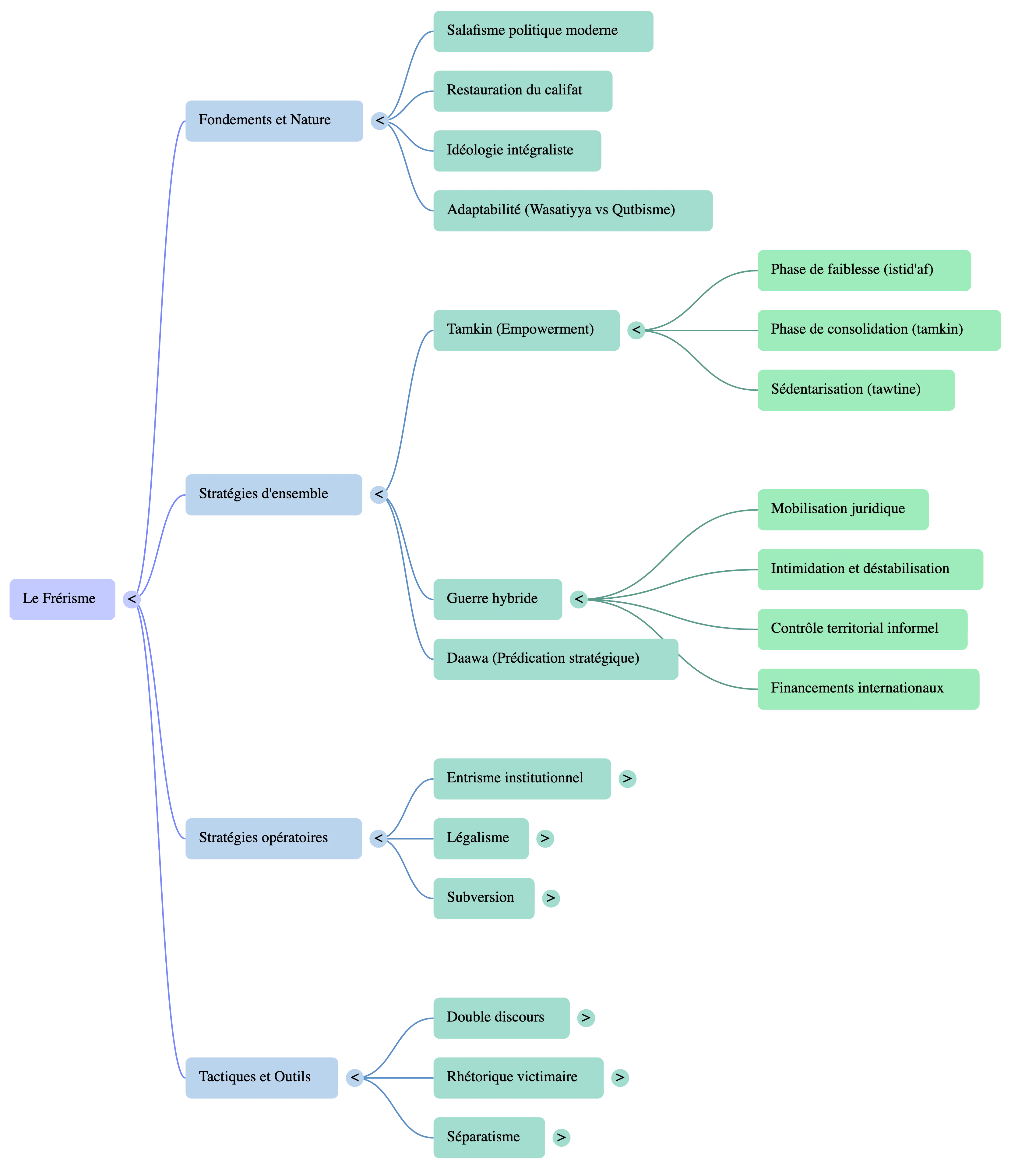
brotherism refers to the ideology and strategy inspired by the Muslim Brotherhood since their founding in 1928 by Hassan al-Banna. Unlike Salafism (which focuses on individual piety) or jihadism (the use of armed violence), brotherism favours a slow, institutional transformation of host societies. The following concepts provide a framework for understanding it, organised from doctrinal foundations to tactical methods of action.
I. A modern and expansionist form of political Salafism
A framework for action towards the caliphate
For Florence Bergeaud-Blackler, the brotherist system of action is a programme aimed at restoring the caliphate and extending its reach across the world. It is not limited to a centralised organisation or solely to the Muslim Brotherhood brotherhood in the strict sense; rather, it refers to an ideological, social and political modus operandi based on the gradual dissemination of Islamic norms within the everyday spheres of democratic life. This system operates less through open confrontation than through entryism, a network of associations, victim rhetoric, legal mobilisation, scholarly legitimisation and engagement with social mediators – education, culture, social action, consumption, the fight against discrimination, and the representation of Muslims. It thus aims to create a normative environment conducive to the gradual Islamisation of practices and frameworks of perception, advancing through legal (hence its designation as legalist Islamism), respectable and institutionally acceptable means. From this perspective, brotherism is a system of indirect action, seeking less a brutal seizure of power than a transformation of the rules of the game, collective sensibilities and thresholds of acceptability within European societies.
Why refer to it as brotherism?
It is called “brotherism” precisely so as not to reduce the phenomenon to the organisation of Muslim Brotherhood in the strict sense.
The term serves to distinguish between two things:
- On the one hand, there is the historic brotherhood, with its structures, branches, leaders and formal members.
- On the other hand… there is a broader system of action that stems from it, one that is diffuse and adaptable, which draws on the spirit, aims, repertoires and methods of the brotherist matrix without necessarily involving explicit organisational affiliation.
It is characterised by several key concepts:
1. Fundamentalism
brotherism is described as a political-religious ideology of a fundamentalist nature, of which the Muslim Brotherhood are “the first group to claim allegiance to it” and “initially formed its foundation” [4]. Fundamentalism combines three dimensions: an apologetic vision producing a canonical standard, a dimension of social realisation that is both collective and individual, and a political aim centred on Sharia but adapted to a secularised space [4]. The aim is to subject all spheres of life – economic, educational, cultural, legal and political – to Islamic norms, through gradual means compatible with the institutional structures of the host society. Fundamentalism constitutes the ultimate goal to which all other concepts are subordinated.
2. Adaptability
The strength of brotherism lies in its ability never to replicate its model exactly as it is, but to adapt and reinterpret it in line with the political context and the position of Muslims within the host society. This adaptability explains its strength and its global spread. There are two main ideological strands: that of Hassan al-Banna, known as wasatiyya (Islam of the middle way), for which Youssef al-Qaradawi is the principal contemporary authority; and that of Sayyid Qutb (1906–1966), which is more radical and whose thinking has served as the foundation for several violent, even terrorist, groups. This flexibility allows for the coexistence, within the same movement, of seemingly contradictory discourses depending on the target audience. Adaptability is the quality that enables fundamentalism to function in non-Muslim contexts.
II. Overall strategies
3. Tamkin (empowerment / consolidation)
Tamkin (Arabic for ‘establishment’, ‘consolidation’, ‘empowerment’) is a central concept in brotherist thought, referring both to an ultimate goal – the global political domination of Islam – and to the step-by-step strategy for achieving it.
It is rooted in the Qur’anic distinction between marhalat al-istid’āf (the phase of weakness, the Meccan period) and marhalat al-tamkīn (phase of empowerment, Medinan period), which provides the strategic framework for Muslim Brotherhood: as long as the ummah is in a position of weakness in a given territory, preaching (da'wa), concealment and institutional work are prioritised; once strength has been attained, the imposition of Islamic norms becomes possible.
According to the Libyan theorist 'Ali al-Sallabi, tamkin refers to ‘the dominance of Islam over all other religions and its sovereignty over the whole of humanity’. In the brotherhood’s internal literature, this objective is to be achieved through four successive stages: (1) the propagation of Islam, (2) the selection and training of individuals, (3) the addressing of structural weaknesses, (4) tamkin proper.
The main primary sources are the ‘Tamkine Document’ (13 pages) seized by the Egyptian police in 1992, and “The Project” seized in 2001 near Lugano at Youssef Nada’s villa, analysed by Sylvain Besson (La Conquête de l’Occident, Seuil, 2005). The writings of Yūsuf al-Qaradawi theorise the conditions for the shift between the two phases. The concept is frequently associated with tawtine (settlement / sedentarisation), a strategy for establishing a territorial foothold in the West documented in particular by Mohamed Louizi.
4. Hybrid warfare
Hybrid warfare by Muslim Brotherhood refers to the coordinated combination of non-military means to gradually transform host societies. Effective counterstrategies “can only succeed if the hybrid nature of the Muslim Brotherhood’s approach has been fully elucidated ” [11]. It encompasses several simultaneous areas of action: the legal sphere (favourable precedents, reputational costs for critics, normalisation of positions) [7]; targeted intimidation, which no longer targets only political and media opponents but “increasingly also judges, prosecutors, teachers and civil servants” [17]; destabilisation (isolation of critics, public shaming, normalisation of violence as a means of confrontation) [17]; informal territorial control (taking on “informal policing functions to control predominantly Muslim neighbourhoods”) [17]; funding, with substantial contributions coming notably from Qatar, Kuwait and Turkey [21].
5. Da’wah (strategic preaching)
Da'wah, or preaching, is one of the driving forces behind the gradual Islamisation of societies. It is used by all Islamist movements but occupies a distinct position: dominant amongst Salafists and Tablighis, it remains important for the Muslim Brotherhood who combine it with institutional entryism [4]. In the context of brotherist, daawa is aimed less at individual religious conversion than at the gradual establishment of an Islamic framework within European Muslim communities.
III. Operational strategies
6. Entryism
Entrism is the key strategy of brotherism in the European context. The French Ministry of the Interior defines it as the “proactive approach taken by certain separatist actors or movements to infiltrate institutions, public or private associations or organisations with the aim of gradually imposing a political vision of Islam, often by concealing their true intentions behind rhetoric that appears to conform to republican principles” [6].
This strategy is based on three key elements: concealment, double standards and victimisation [6, 15]. These three elements function as an integrated system:
- Concealment consists of concealing the organisational identity brotherist itself and its true doctrinal objectives: undeclared structural affiliations, opaque funding, and an extremist doctrine that is suppressed in the public sphere. It is based on a culture of secrecy inherited from the founding of the Brotherhood by Hassan al-Banna [6].
- Double standards consists of adopting two different discourses depending on the target audience: a polite, republican discourse aimed at institutions, the media and the wider Western public; and a doctrinal, fundamentalist discourse aimed at the faithful, often in Arabic, in internal sermons or theological writings [15].
- Victimisation consists of portraying oneself as a victim of structural hostility within Western societies (notably through the concept of ‘Islamophobia’) in order to neutralise criticism, mobilise political and legal alliances, and frame critical examination of the ideology as an attack on Muslims as a group [6, 15].
Entrism relies on the targeted recruitment of elites (engineers, lawyers, academics, business leaders) in strategic positions, and on systematic engagement with local, national, European and international institutions [15]. In Europe, the Muslim Brotherhood have deliberately refrained from forming Islamist parties in order to prioritise this long-term strategy of influence.
7. Legalism
Legalism refers to the strategic use of the democratic legal framework by Muslim Brotherhood as the primary vehicle for transforming host societies. It constitutes the methodological hallmark of the European brotherism, which has explicitly renounced – in a Western context – the violent or revolutionary seizure of power in favour of the legal avenues offered by the rule of law. brotherist legalism operates on three interlinked levels: formal compliance with the rules of the rule of law (establishment of associations under the 1901 Act or equivalent non-profit organisations, compliance with reporting obligations, application for public grants, participation in institutional dialogue mechanisms with religious groups); the proactive use of the law (using the courts to establish favourable precedents, systematic recourse to anti-discrimination legislation to transform “the legitimate scrutiny of Islamist ideology into actionable violations of civil rights ’ and ‘normalising its positions by establishing legal frameworks favourable to its long-term objectives’) [7]; the gradual reconfiguration of norms through the mobilisation of human rights legal frameworks and international instruments (UN, Council of Europe, OIC). Legalism thus structurally distinguishes brotherism from jihadism: whereas the latter directly challenges the legitimacy of the Western legal order, brotherism appropriates it as a resource and a battlefield.
8. Subversion
Subversion brotherist is a form of non-violent jihad that “does not directly employ physical violence, but rather psychological coercion”. It consists of “turning the enemy’s strength against them without them realising it, getting them to change their behaviour and renounce their values of their own accord” [8]. This patient process employs three levers: diversion, demoralisation and double-speak [8]. Subversion aims in particular to make Islamic interpretative frameworks the dominant discourse in politics, the media and academia, and to delegitimise any criticism by labelling it “Islamophobia” or “hostility towards Islam” [21]. It constitutes the dominant form of jihad in secularised Western societies, distinct from offensive and military jihad [8]. Legalism and subversion form an operational pair: the former provides the façade of respectability that the latter exploits in depth to reconfigure the mental and moral categories of host societies.
9. Communitarianism / separatism
Communitarianism brotherist refers to the gradual formation of a Muslim community organised as a relatively autonomous collective space, with its own institutions and networks in the voluntary, educational, media, economic and, at times, political spheres. This logic can take a communitarian form when it primarily aims to reinforce a distinct sense of belonging within wider society; it can evolve towards separatism when it tends towards the practical rejection of common norms in favour of competing ones. But neither communitarianism nor separatism is sufficient to fully define its dynamics. Their underlying aim is expansionist: it is not merely a matter of setting oneself apart, but of extending influence, exerting pressure on the social and institutional environment, and gradually transforming the rules of the game. It is from this perspective that we must understand the means of influence, entryism and infiltration: they are not peripheral, but lie at the heart of a strategy of dissemination, establishment and normative conquest. Communitarianism thus constitutes its social basis, separatism one of its possible forms, and entryism one of the main modes of operation serving a logic of expansion.
IV. Tactics
10. Double standards
Double-speak is the second pillar of the triptych of entryism (see §6). It involves publicly professing adherence to republican and democratic values whilst, behind the scenes, pursuing objectives that are incompatible with them [15]. It serves to reassure institutions, secure public funding, gain legitimacy among elected representatives and maintain internal doctrinal cohesion. In this regard, the DGSI emphasises that the brotherhood “presents an elitist, educated, and therefore reassuring image, which it combines with outreach to local, national, European and global institutions with the aim of legitimising itself” [15]. It operates both as a discursive tactic (selecting the appropriate tone depending on the audience) and as a lever for subversion (contributing to the demoralisation of host societies through the dissonance maintained between public displays and actual objectives).
11. Victimisation
Victimisation is the third pillar of the triptych of entryism (see §6). It consists of portraying oneself as a victim of a Western society that is supposedly structurally hostile (notably through the category of ‘Islamophobia’), in order to neutralise criticism, mobilise political and legal alliances (human rights, anti-racism, decolonialism) and to secure moral legitimacy in the public sphere. It transforms critical examination of the ideology into an attack on Muslims as a group [6, 15]. It also serves as the main discursive fuel for offensive legalism, which turns it into a contentious instrument before national and European courts.
References cited
Full-text sources in the CERIF document database
Institutional and parliamentary reports
- [3] Groupe de travail LR présidé par la sénatrice Jacqueline Eustache-Brinio, L'islamisme : obstacle à notre cohésion nationale ?
- [4] Ministère de l'Intérieur (France), Frères musulmans et islamisme politique en France.
- [6] Assemblée nationale ; Xavier Breton ; Matthieu Bloch, Rapport fait au nom de la Commission d'enquête sur les liens existants entre les représentants de mouvements politiques et des organisations et réseaux soutenant l'action terroriste ou propageant l'idéologie islamiste, p. 47.
- [10] Comité R Belgique - services de renseignements, Enquête de contrôle relative au suivi par les services de renseignement des Frères musulmans et de la menace éventuelle que ceux-ci constituent en Belgique, p. 8.
- [15] Assemblée nationale ; Xavier Breton ; Matthieu Bloch, Rapport fait au nom de la Commission d'enquête […], p. 48.
Research papers and expert reports
- [1] Florence Bergeaud-Blackler, Le frérisme et ses réseaux.
- [2] Arbeitskreis Politischer Islam (AK Polis), Gründungsresolution, p. 2.
- [11] Heiko Heinisch, Nina Scholz, Gustav E. Gustenau, Politischer Islam hybride Bedrohung (traduction DeepL française).
- [17] Heiko Heinisch, Nina Scholz, Gustav E. Gustenau, Politischer Islam hybride Bedrohung (traduction DeepL française).
- [21] Heiko Heinisch, Nina Scholz, Gustav E. Gustenau, Politischer Islam hybride Bedrohung (traduction DeepL française).
Network studies Muslim Brotherhood
- [5] The Institute for the Study of Global Antisemitism and Policy (ISGAP), L'influence croissante de la confrérie des Frères musulmans sur la politique, le monde universitaire et la société civile au Canada (trad. fr.), p. 15.
- [7] ISGAP, The Muslim Brotherhood's Strategic Entryism into the United States: A Systemic Analysis, p. 72.
- [9] ISGAP, An Examination of SJP's Messaging and Recruitment Tactics, p. 68.
- [12] ISGAP, The Growing Influence of the Muslim Brotherhood on Politics, Academia and Civil Society in Canada, p. 20.
- [14] ISGAP, L'influence croissante de la confrérie des Frères musulmans […] au Canada (trad. fr.), p. 15.
- [18] ISGAP, The Growing Influence of the Muslim Brotherhood […] in Canada, p. 15.
- [19] ISGAP, L'influence croissante de la confrérie des Frères musulmans […] au Canada (trad. fr.), p. 7.