





Scientific direction
Dr. Florence Bergeaud-Blackler
President, CERIF

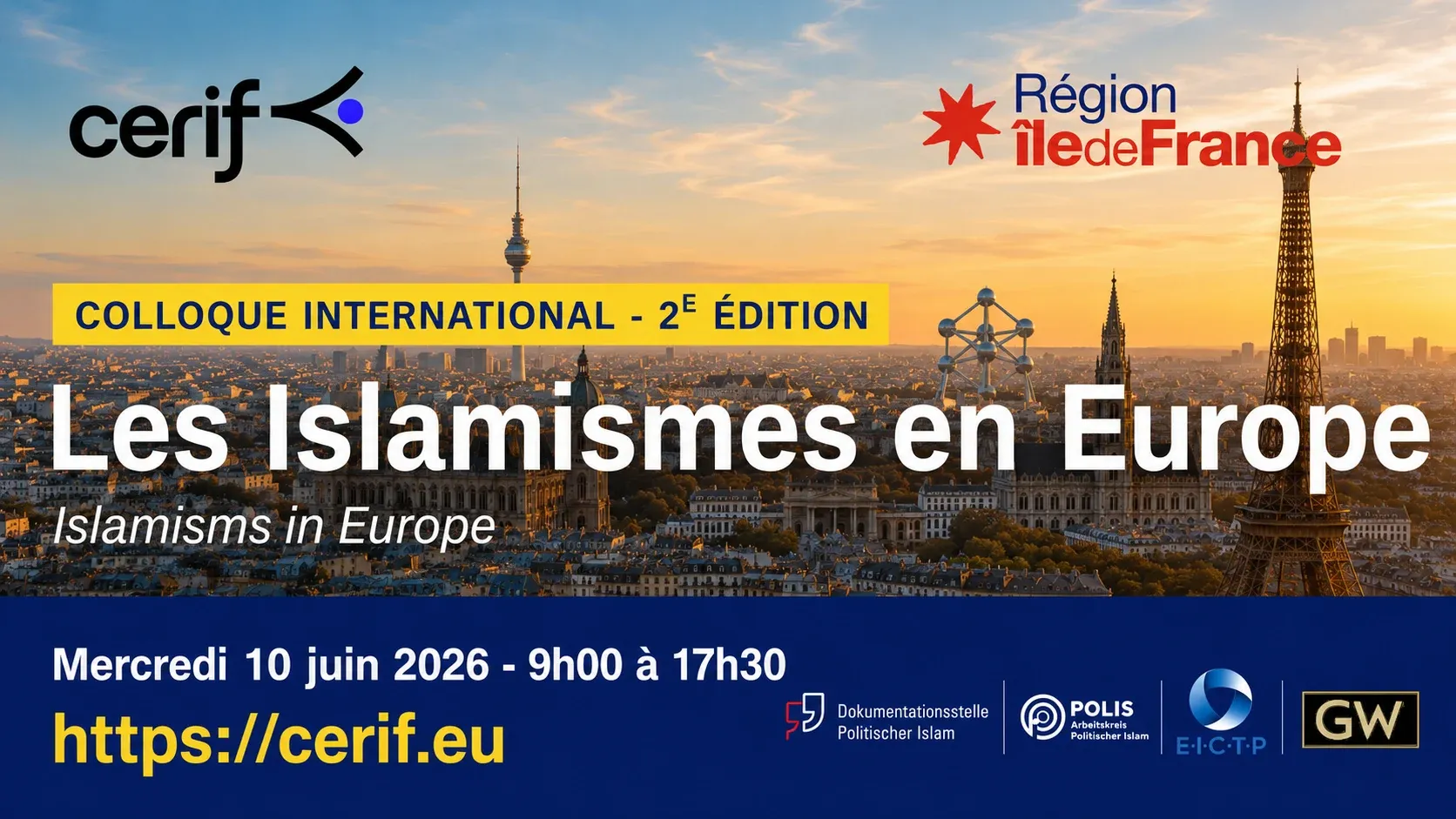
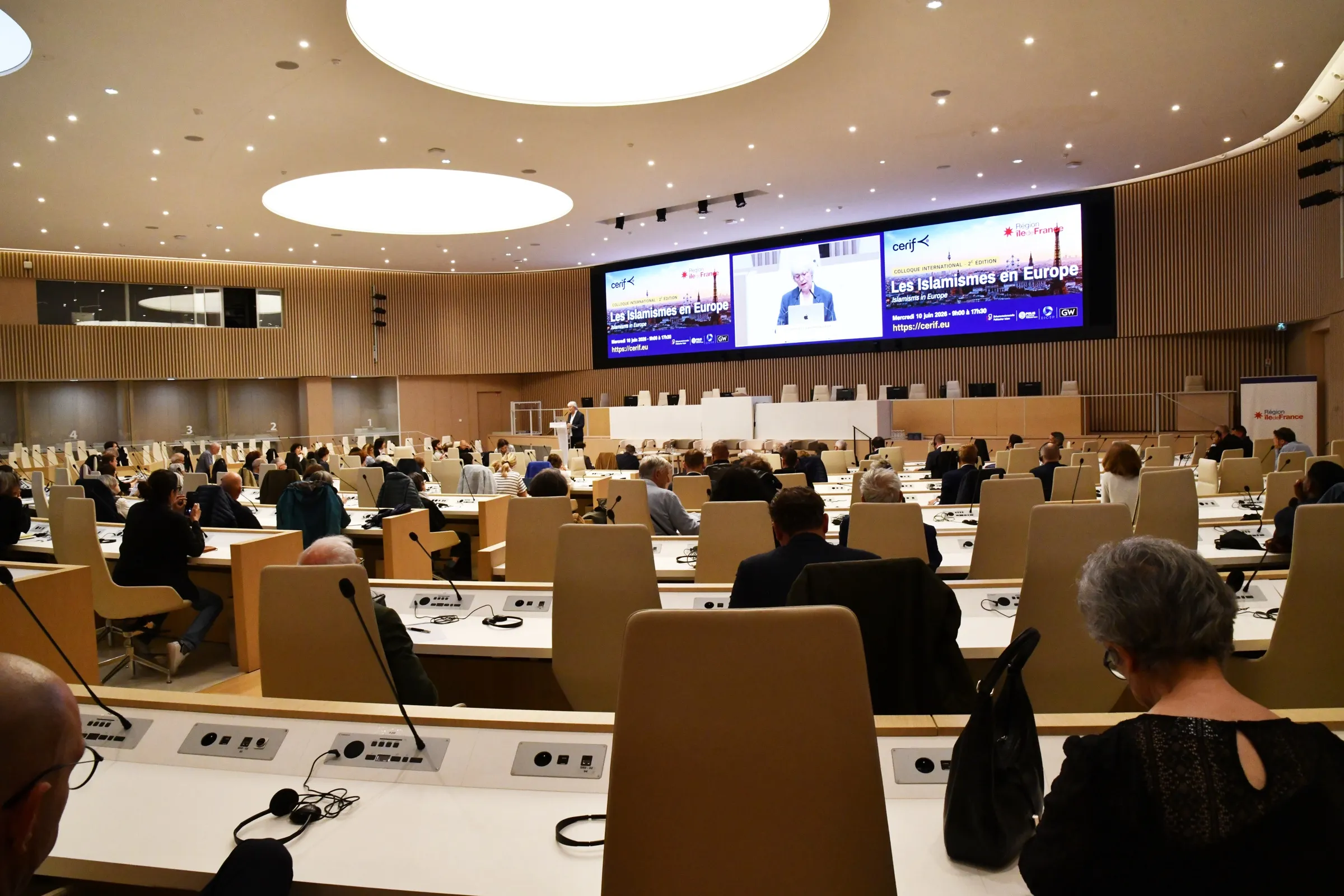
Watch all the talks from the conference.
💬 Subtitles: the language of each video is shown in yellow on its thumbnail. To display subtitles in English, start the video, then click the Subtitles icon at the bottom of the YouTube player, then ⚙️ Settings → Subtitles → Auto-translate → English.
Conceived as a demanding forum for exchange between researchers, public decision-makers and civil society actors, this conference, initiated by CERIF, aims to share with the wider public the scientific research on the contemporary manifestations of Islamisms in Europe: their structures, doctrines, networks, strategies of influence and the responses that liberal democracies bring to bear on them. Some of the leading European and American specialists on the subject, whose research is today at the forefront of the field, have been invited to take part in this day. Each is asked to present, in fifteen minutes and in an accessible format, some of the most important findings of their work.
By Patrick Karam, Vice-President in charge of Sports, Olympic and Paralympic Heritage, Citizenship and Leisure.
The Île-de-France Region is hosting, for the second time, the international conference on Islamisms in Europe, reaffirming its steady commitment to free research, democratic debate and the scientific study of the phenomena running through European societies.
By Florence Bergeaud-Blackler, President of CERIF, anthropologist (CNRS / GSRL).
Florence Bergeaud-Blackler will review the progress of research since the first conference in May 2024, present the structuring themes of this second edition and outline the comparative, multidisciplinary approach that brings together speakers from five countries. She will introduce in particular the issues raised by her latest book, Le djihad par le marché (Odile Jacob, 2025).
 Florence Bergeaud-Blackler CNRS / CERIF - France "Jihad through the market" 🇫🇷 France
 Florence Bergeaud-Blackler holds a doctorate in anthropology (HDR) and is a researcher at the CNRS (GSRL laboratory) and founding President of CERIF. She has thirty years of fieldwork experience in the areas of Islamic normativity, Salafism and Islamist networks in France and across Europe. Her research combines the anthropology of religious norms, the political economy of the halal market and the organisational strategies of Islamism. She is regularly called to testify before parliamentary committees in France and abroad. She was made a Chevalier of the Légion d’honneur in 2024.
Le Djihad par le marché (Odile Jacob, 2025); Le Frérisme et ses réseaux. L’enquête (Odile Jacob, 2023); Unmasking The Muslim Brotherhood. Brotherism, Islamophobia and the EU (with T. Virgili), ECR Group, European Parliament, 2025.
An anthropological and political analysis of how the economy - and in particular the halal market - has become a strategic terrain for contemporary Islamic fundamentalism. The paper links the political economy of halal to Brotherist organisational strategies, in order to grasp how the market can be instrumentalised as a vehicle for ideological expansion in Europe.
This first panel opens the day with a state-of-the-art overview of contemporary knowledge on the Muslim Brotherhood in Europe. How can one describe a movement that is transforming and fragmenting, while remaining coherent in its strategies of influence? Three researchers - from Washington and Vienna - offer three complementary readings: from the mapping of structures to transnational logics, and on to the preventive dimension of knowledge production.
Format: Three 15-minute papers, followed by 30 minutes of discussion with the audience.
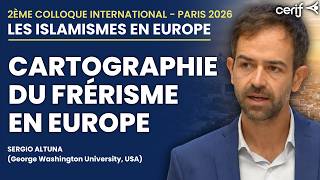
 Sergio Altuna George Washington University - Program on Extremism "Mapping the Muslim Brotherhood in Europe: fragmentation, networks and the logics of interdependence" 🇺🇸 United States
 Dr Sergio Altuna is a senior researcher at the Program on Extremism at George Washington University. A specialist in contemporary Islamist thought, jihadist narratives and violent non-state actors in the Maghreb and the Sahel, he leads the TITAN project devoted to the computational analysis of jihadist propaganda. He has previously worked for NATO, the Japanese Ministry of Defense and the Swiss FDFA, and is an associate analyst at the Elcano Royal Institute.
Rather than treating the fragmentation of the Muslim Brotherhood in Europe as evidence of decline, Sergio Altuna will offer a concise mapping of it, situating actors, networks and affiliated structures in relation to competing transnational centres of gravity (London–Istanbul–Qatar). He will argue that Muslim Brotherhood-linked groups in Europe operate according to a logic of simultaneous competition and interdependence, sharing discursive frames and network ties while pursuing distinct forms of legitimacy. This reconfiguration calls for network-based rather than organisation-centred approaches.
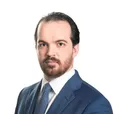 Ferdinand Haberl DPI - Vienna "Knowledge as prevention: the DPI and the strategies of the Muslim Brotherhood" 🇦🇹 Austria
 Ferdinand Haberl is an orientalist and researcher specialising in political Islam, jihadism, security in the MENA region and prevention strategies within the field of Preventing and Countering Violent Extremism (P-CVE). He serves as Deputy Director of the Documentation Centre for Political Islam in Vienna, where he is responsible for the centre’s scientific direction and oversees the implementation of various research projects. In addition, he is an ERCOR researcher within the European Commission’s Radicalisation Awareness Network (RAN), contributing to evidence-based policymaking at the European level. His academic work includes a range of publications on jihadist military strategies and security-related issues, including monographs and edited volumes with international academic publishers. As Co-Lead of the panel "Local Dimensions, Polarisation and Resilience" within the EU Knowledge Hub, he contributes to advancing evidence-based approaches to addressing societal polarisation and extremism across Europe. He holds a PhD in Oriental Studies from the University of Vienna, an LL.M. in Law from the University of Edinburgh, and Master’s degrees in Islamic Studies as well as Security Studies.
Religiously Motivated Political Extremism in Europe (Brill, edited volume, forthcoming 2026); Revisiting the Grayzone (Springer, forthcoming 2026); Jihadi Intelligence and Counterintelligence (Springer, 2023); The Muslim Community in Austria and the Rule of Law (KIRAS/FFG, 2022, co-authored); The Retreating into the Desert (Logos, 2019).
The Muslim Brotherhood is one of the most influential transnational movements within political Islam. In Europe, its significance lies less in open confrontation than in its ability to operate through legalist structures, civil society organisations and educational initiatives. Drawing on the Austrian Documentation Centre on Political Islam (DPI), Ferdinand Haberl will show how the production of scientific knowledge, public communication and the translation of findings for educators, the media and decision-makers constitute a genuine democratic counter-strategy against legalist Islamist movements - whose effectiveness often depends on ambiguity and low visibility.
 Alexander Weissenburger Dokumentationsstelle (Vienna) "Islamist Missionary Activities and their Connection to the Muslim Brotherhood" 🇦🇹 Austria
 Alexander Weissenburger is head of research and senior researcher at the Austrian Fund for the Documentation of religiously Motivated political Extremism (Dokumentationsstelle). He is a member of the EU Knowledge Hub on Prevention of Radicalization, worked as a researcher at the Austrian Academy of Sciences and as a lecturer at the University of Vienna. His research focuses on the Huthi movement in Yemen and Salafi missionary activities in Europe.
This paper examines IMAN, a Salafi missionary organisation primarily active in the DACH region. The organisation is dedicated to the Islamisation of European societies and active both on- and offline. Despite its Salafi persuasion, it shares core narratives of the milieu of the European Muslim Brotherhood and also appears to have personal links into circles of the Brotherhood. The paper argues that especially in a European context, practical considerations and shared goals help to bridge cleavages between different strands of Islamism. Despite their different historical trajectories and ideological as well as strategic differences, Islamist actors such as Salafis or the Muslim Brotherhood can unite behind the shared vision of an Islamised society and work towards that goal in a joint manner.
A 15-minute break in the foyer of the Regional Council. A dedicated area is provided for informal exchanges with the speakers and for consulting the publications of the conference’s institutional partners.
School and university are, in France as elsewhere in Europe, decisive sites for the transmission of republican and democratic values. As such, they are also prime targets of Islamist entryism. Two French researchers, a historian and a geographer, set out the contemporary forms of this "war over schools" and this "university entryism", drawing on observed and documented cases.
Format: Two 15-minute papers, followed by 30 minutes of discussion with the audience.
 Pierre Vermeren Université Paris 1 Panthéon-Sorbonne "The war over schools, from the French case" 🇫🇷 France
 Pierre Vermeren is professor of contemporary history at Université Paris 1 Panthéon-Sorbonne. A graduate of the ENS Fontenay-Saint-Cloud and agrégé in history, he is one of France’s leading specialists on the Maghreb and Arab-Berber societies. He heads the CIAMO master’s programme (International Cooperation in Africa and the Middle East) and co-edits the "Bibliothèque des pays d’Islam" series at Publications de la Sorbonne. He chairs the Société française d’histoire d’outre-mer.
Déni français (Albin Michel, 2019); Le Choc des décolonisations (Odile Jacob, 2015, repr. 2023); La Formation des élites au Maroc et en Tunisie (La Découverte, 2002); Histoire du Maroc depuis l’indépendance (La Découverte, 2002, repr. 2016).
The school of the Republic is, for the Muslim Brotherhood, an institution that jeopardises their worldview and their conception of religion. The attempts to scuttle, neutralise or paralyse it are many and reach parents, pupils, teachers, the administration, school outings, canteens, dress codes and the mixing of the sexes. Behind set-piece talk of the pursuit of science or of "Islamic schools of excellence" lies, at ground level, a crucial battle waged against the secular State.
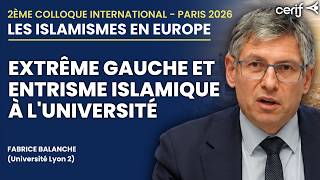
 Fabrice Balanche Université Lyon 2 - Senior Lecturer (HDR) "The grip of the far left on universities facilitates Islamist entryism" 🇫🇷 France
 Fabrice Balanche is a senior lecturer (HDR) in geography at Université Lyon 2 and a specialist in the political geography of the Middle East, particularly Syria and Lebanon. He was a visiting fellow at the Washington Institute for Near East Policy (2015–2017) and at the Hoover Institution at Stanford (2017–2018). His book <i>Les leçons de la crise syrienne</i> was awarded the 2024 Prix du livre de géopolitique.
Les leçons de la crise syrienne, preface by Gilles Kepel (Odile Jacob, 2024); Sectarianism in Syria’s Civil War (Washington Institute, 2018); Atlas du Proche-Orient arabe (PUPS / RFI, 2012).
At university as elsewhere, the Islamists’ aim is to entrench separatism. Infiltration takes various forms, through the association "Les Étudiants Musulmans de France" and left-wing trade unions, and finds militant allies within the academic milieu. The incident of April 2025, when Fabrice Balanche’s lecture hall was invaded by an Islamo-leftist commando, will illustrate the most common pattern of entryism: the one that exploits the grip of the far left over the humanities, social and political sciences.
Lunch break of one hour and thirty minutes.
From Washington to Westminster and on to Brussels, democracies are going through, in 2025–2026, a moment of redefinition of their stance towards legalist Islamism and the legal and political notions that accompany it. This panel brings together three salient case studies - the recent wave of American designations, the British adoption of a non-statutory definition of "anti-Muslim hatred", and the penetration of Brotherist networks within the institutions of the European Union - and examines their implications for continental Europe.
Format: Three 15-minute papers, followed by 30 minutes of discussion with the audience.
 Lorenzo Vidino George Washington University - Program on Extremism "Recent US measures against the Muslim Brotherhood: legal issues and implications for Europe" 🇺🇸 United States
 Lorenzo Vidino is director of the Program on Extremism at George Washington University. A lawyer by training and holding a PhD in international relations (Fletcher School, Tufts), he is one of the world’s foremost experts on Islamism in Europe and North America. He has held positions at the Belfer Center at Harvard, the U.S. Institute of Peace, the RAND Corporation and the Center for Security Studies at ETH Zurich. He has testified before the US Congress and several European parliaments.
In recent months, the US authorities have taken various measures against the Muslim Brotherhood. While the Trump administration designated four branches of the group, Texas and Florida designated the organisation as a whole, along with the Council on American-Islamic Relations (CAIR), whose ties to the Muslim Brotherhood and Hamas are well documented. The presentation will examine the political context and legal implications of these measures and assess their potential consequences for the Muslim Brotherhood in Europe.
 Sir John Jenkins Policy Exchange - Senior Fellow "The British definition of anti-Muslim hatred (2026)" 🇬🇧 United Kingdom
 Sir John Jenkins is a former British diplomat. Over a 35-year career, he served as ambassador to Saudi Arabia, Iraq, Syria and Burma, consul general in Jerusalem, British special representative to the National Transitional Council and then ambassador to Libya during the 2011 revolution. He headed the Middle East and North Africa Department at the Foreign Office and was the principal author of the British government’s review of the Muslim Brotherhood (2014). He is currently a senior fellow at Policy Exchange.
In March 2026, the British government published a "non-statutory definition of anti-Muslim hatred". Sir John Jenkins will retrace its genealogy - from the 1997 Runnymede report and the controversies surrounding the work of the APPG in 2018, through to the confidential consultations conducted under the Labour government of 2024. He will analyse its political underpinnings and the modalities of its implementation, and discuss its foreseeable effects on social cohesion, freedom of expression and the future of liberal democracy in the United Kingdom - with lessons for the whole of Europe.
 Tommaso Virgili AJC Transatlantic Institute / WZB Berlin / Wilfried Martens Centre "Unmasking the Muslim Brotherhood: Brotherism, Islamophobia and the European Union" 🇪🇺 European Union
 Tommaso Virgili is a legal scholar specialising in comparative law in Islamic countries. He is a senior policy advisor at the AJC Transatlantic Institute, a visiting researcher at the WZB Berlin Social Science Center and a research associate at the Wilfried Martens Centre for European Studies. His research focuses on the networks of the Muslim Brotherhood in Europe, legalist Islamism in Italy and the EU, freedom of conscience in Muslim-majority countries and the interactions between integration policies and religious fundamentalism. He is an expert for CERIF.
Unmasking The Muslim Brotherhood (with F. Bergeaud-Blackler), European Parliament, 2025; Islam, Constitutional Law and Human Rights (Routledge, 2022); Network of Networks: the Muslim Brotherhood in Europe (with P. Stott), European Parliament, 2021.
The paper examines the penetration of the Muslim Brotherhood and its ideology - "Brotherism" - within the European Union, and the way in which affiliated organisations exploit funding and institutional access to advance their agenda. Following the model of al-Mawdudi and Yusuf al-Qaradawi, these networks have managed to embed their vocabulary in public debate - first and foremost the rhetoric of "Islamophobia" - in order to align themselves with European political and associative actors. The paper concludes by underlining the urgent need for reforms to protect Europe’s secular, liberal and democratic values.
A 15-minute break - refreshments and informal exchanges with the speakers.
What do we empirically know about actual support for fundamentalist ideologies within European societies? How can democracies build, through knowledge, their resilience to foreign soft power’s religious instrumentalisations? This final panel combines quantitative sociology and public prevention policies, drawing on the German and Austrian cases.
Format: Two 15-minute papers, followed by 30 minutes of discussion with the audience.
 Gustav Gustenau EICTP - Vienna « The Strategy of the MB in Europe and how to counter it » 🇦🇹 Austria
 Gustav Gustenau, Brigadier General (ret.), Mag., has served as Secretary General of the European Institute for Counter Terrorism and Conflict Prevention (EICTP) in Vienna since 2019. His research has focused on strategic foresight analysis, risk assessment and security development across various fields of security policy. He worked for the Austrian Ministry of Defence between 2000 and 2021, notably as a liaison officer at the National Security Office. He also held a position as a researcher at the Institute for Strategic Research at the National Defence Academy, focusing in particular on the Former Yugoslavia between 1989 and 1997. Between 1997 and 2001 he served as Director of the Institute for International Peace Support at the National Defence Academy in Vienna. Gustenau studied modern history, political science and philosophy at the University of Vienna.
How should we assess the threat the Muslim Brotherhood poses in Europe? Drawing on the tools of strategic analysis, Gustav Gustenau will argue that the movement should no longer be seen as a fragmented patchwork, but understood as a coherent strategic actor pursuing long-term goals. Its approach is hybrid and adaptive: it aims at the gradual transformation of societies and generates a risk that goes well beyond security alone, reaching state institutions and social cohesion. Gustenau will show that the Brotherhood adjusts its courses of action to each national context, depending on the opportunities and constraints of the moment. His conclusion: only by grasping this overall strategic logic can democracies build effective, anticipatory counter-strategies that tackle the root causes rather than merely the symptoms.
 Ruud Koopmans WZB Berlin Social Science Center / Humboldt-Universität zu Berlin "Fundamentalist attitudes among European Muslims: an empirical overview" 🇩🇪 Germany · 🇳🇱 Netherlands
 Ruud Koopmans is research director at the WZB in Berlin and professor of sociology and migration research at Humboldt University of Berlin. One of the most-cited European sociologists in the field of immigration and integration studies, he has served on the advisory board of the German Federal Office for Migration and Refugees (BAMF) and sits on the board of DeZIM (the German Centre for Integration and Migration Research).
Das verfallene Haus des Islam (C.H. Beck, 2020); Die Asyl-Lotterie (C.H. Beck, 2023); Contested Citizenship (University of Minnesota Press, 2005).
This paper presents a synthesis of the research and data available on support for fundamentalist Islamic attitudes and ideologies among the general Muslim public in several European countries, compared, where possible, with those in countries of origin. It provides an empirical indication of the scale of grassroots support enjoyed by Islamist organisations in Europe - and of the extent to which Islamist actors, in Europe and in the Muslim world, continue to shape the attitudes of Muslims in the European diaspora.
To close the day, a round table chaired by Florence Bergeaud-Blackler (CERIF), Andreas Jacobs (Konrad Adenauer Foundation, KAS) and Pierre Liscia (member of the Île-de-France Regional Council), reflecting on the day’s presentations and extending the discussion to the question of antisemitism.
Words of thanks from the President of CERIF, Florence Bergeaud-Blackler, and from the academic partners: George Washington University - Program on Extremism, Dokumentationsstelle Politischer Islam (Vienna), European Institute for Counter Terrorism and Conflict Prevention, AK Polis. With the support of the Conseil régional d’Île-de-France.
Dr. Florence Bergeaud-Blackler
President, CERIF