
Key points
- The article examines how the internet, social media and algorithms are changing the way religious opinions (fatwas) are produced and recognised in the Muslim world.
- The author compares two situations: traditional religious authority, grounded in the training of scholars and institutional control, and online authority, where what counts above all is visibility, algorithms and audience.
- He examines this comparison from three angles - knowledge, institutions and communication - then assesses it against the major objectives of Islamic law (the maqāṣid).
- His main conclusion: the digital sphere, in itself, does not make the opinion invalid. The real risk comes from the disappearance of oversight by qualified scholars, from the proliferation of pseudo-fatwas spread by influencers and by artificial-intelligence tools incapable of judging in conscience.
- This is a theoretical study, with no field investigation.
1. Overview
- Object. The article seeks to understand how the digital sphere - websites, social media, algorithms and artificial-intelligence tools - transforms the religious authority expressed through the fatwa, the legal opinion specific to Islam.
- Proposed framework. The author builds an analytical grid that brings together two rarely combined approaches: the classical theory of Islamic law and the study of the role of the media.
- Central question. Does the digital sphere profoundly change the way a fatwa is drawn up, recognised and accepted?
- Positioning. The author extends the work on the influence of the media in religious life and aims to fill a gap: until now, no framework linked Islamic law, the theory of the fatwa and media studies.
- Source. Religions (MDPI), 2026, vol. 17, art. 350; special issue “Religion, Culture and Spirituality in a Digital World”.
2. Methodology
- Type. A qualitative and comparative study, which builds an analytical framework; with no interviews, surveys or statistics.
- Step 1. The author first describes the classical model of the fatwa from two major early legal texts (Ibn al-Ṣalāḥ, 1986; Ibn Qayyim al-Jawziyyah, 1991). This model serves as a reference point.
- Step 2. He then draws a portrait of the digital spaces in which fatwas circulate - websites, religious influencers, AI tools - from the existing literature.
- Step 3. He compares the two situations from three angles: knowledge, institutions and communication.
- Step 4. Finally, he assesses these developments against the major objectives of Islamic law (the maqāṣid): preserving religion, reason and social cohesion.
- Stated scope. The author presents a theoretical reflection, adaptable to different legal schools, and not a set of rules to be applied.
3. Central thesis
The author argues that the digital sphere does not merely broaden access to religious opinions: it changes the very conditions under which religious authority is established, recognised and can be contested. The weight given to online visibility competes with that of evidence-based reasoning; the relationship between the scholar who issues the opinion (the muftī) and the person who seeks it (the mustaftī) is transformed; and artificial-intelligence tools raise unprecedented questions about responsibility and authority.
For the author, the decisive change is not the existence of mediation: print, radio and television were already broadcasting fatwas. What is new is that visibility and legitimacy now depend on algorithms, audience metrics and platform-specific rules. The digital sphere therefore extends an older evolution by amplifying it, rather than breaking with tradition.
4. Argumentative architecture
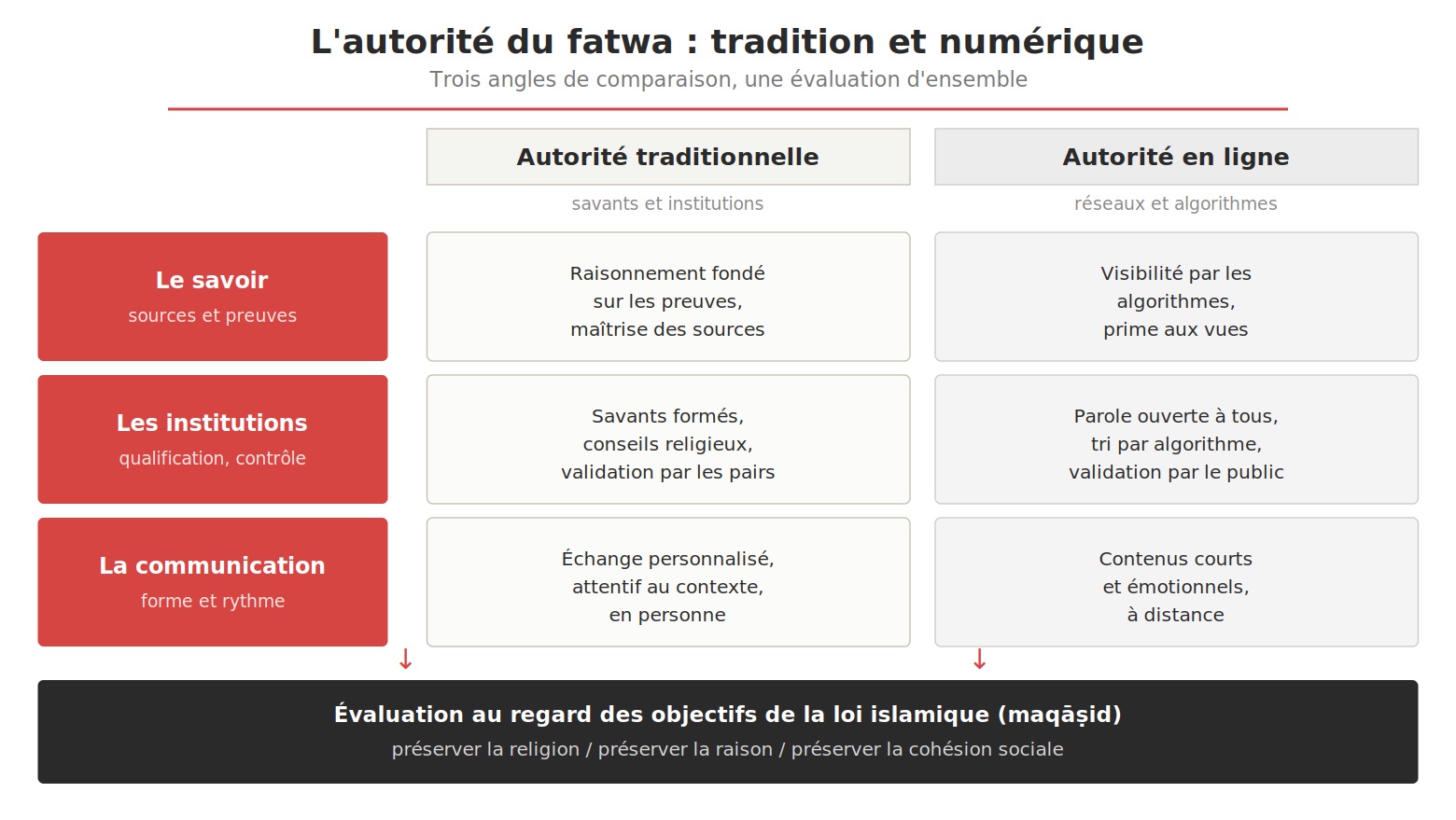
The author builds the argument in five stages, following the three angles of the analysis and their assessment against the objectives of Islamic law. The diagram below summarises the comparison.
Argument 1 - What grounds authority: knowledge
What is shown. The author establishes that, online, two logics overlap. To the soundness of reasoning and command of the sources are added external criteria: visibility, the number of views, virality. The scholar’s authority thus ends up competing with mere popularity.
From what data. The argument brings together the classical texts on the qualities required of a scholar and recent studies on online fatwas and the influence of the media.
Interpretation. The author sees here a reason to broaden the analysis of Islamic law to incorporate the workings of the media, which now bear on the credibility of an opinion.
Argument 2 - Who controls: the role of institutions
What is shown. The author establishes that the traditional filters - the training of scholars, institutional control, peer validation - are partly replaced by digital mechanisms: anyone can speak, the algorithms decide what is seen, and it is the public that validates.
From what data. The argument draws on the classical description of recognised chains of authority, compared with studies on online preachers, on the adaptation of major institutions (such as Nahdlatul Ulama, in Indonesia) and on how the platforms work.
Interpretation. The author does not see this as the disappearance of institutions, but as their transformation: authority now arises both from recognised knowledge and from mastery of digital tools.
Argument 3 - How the opinion circulates: communication
What is shown. The author establishes that the digital sphere changes the very form of the religious opinion: immediate replies, visual and emotional staging, short formats, and a remote relationship with the public that replaces the direct exchange between the scholar and the person consulting them.
From what data. The argument contrasts the classical view of the fatwa - a personalised exchange, attentive to context - with studies on short-form content and on the marketing of religious discourse.
Interpretation. The author considers that this evolution impoverishes the educational dimension of the opinion; they call for markers that preserve reflection, even in short formats.
Argument 4 - Artificial intelligence and the law
What is shown. The author establishes that AI tools, judged by the rules of Islamic law, lack what makes a valid opinion: moral responsibility, sincere intention (niyya), transparent reasoning, attention to context and the capacity to answer for their decisions.
From what data. The finding rests on a comparison between the classical criteria for the validity of a fatwa and recent studies on AI-generated fatwas and their ethics.
Interpretation. The author concludes that AI cannot play the role of a fully-fledged scholar. They propose three safeguards: explain how the tool reaches its answer, correct its biases, and keep a human scholar responsible for the final decision.
Argument 5 - The medium is not the problem
What is shown. The author establishes that, for classical Islamic law, the fact that an opinion passes through the internet does not make it invalid. Legal theory does not distinguish an opinion given in person from one given remotely: what matters is the integrity and competence of the scholar.
From what data. The argument draws on the classical principles for the validity of the fatwa and on an assessment, against the objectives of the law, of the risks linked to influencer content and to AI tools with little attention to context.
Interpretation. For the author, the danger therefore comes not from the medium, but from the absence of oversight by qualified scholars. The digital sphere appears to them double-edged, to be framed by concrete measures: verifying the identity of those who issue opinions, flagging the use of AI, archiving opinions and making them traceable.
5. The author's conclusion
The author concludes that Islamic law does not, in itself, reject the dissemination of fatwas through digital means: an opinion remains valid as long as it comes from a qualified, upright and accountable scholar. The problem lies elsewhere: in the disappearance of oversight by competent scholars, in the proliferation of pseudo-fatwas carried by influencers, and in AI tools incapable of taking context into account and answering for their choices.
Assessed against the objectives of Islamic law, digital dissemination appears double-edged: it can broaden access to reliable guidance and speed up answers, but it can also disperse authority, give weight to marginal positions and expose the public to false information.
The author accordingly sets out several recommendations: that religious institutions develop a serious online presence, with reliable identification of scholars; that their training incorporate knowledge of the media and of AI; and that all actors - scholars, institutions, tool designers, the public - deliberately steer this evolution. They present their analytical framework as a tool to clarify the issues and guide future research.
Florence Bergeaud-Blackler
Anthropologist, Research Fellow at the CNRS (HDR)
Founding President of CERIF - European Centre for Research and Information on Brotherhoodism
cerif.eu
CERIF commentary
Contribution. The study brings together within a single framework two approaches usually kept separate - classical Islamic law and media analysis - to examine religious authority online. Its most useful distinction separates the medium from validity: the problem is not the internet, but the weakening of oversight by qualified scholars. Its examination of AI tools against the classical criteria, together with simple safeguards (explain the answer, correct the biases, keep a human scholar accountable), offers a framework transposable to other areas of online religious authority.
Limitations. The study is purely theoretical: the framework is not tested on concrete cases and the digital spaces are described from the literature, not from direct observation. The reference model is limited to the Sunni tradition, which restricts the scope of the comparisons.
Why read it. To have a clear framework linking Islamic law, the role of the media and the issues raised by AI, useful to anyone who wants to understand how religious authority is being reshaped online and how visibility manufactures legitimacy there.