
Editor’s summary
Two years ago, Professor Lene Kühle of Aarhus University and senior researcher Manni Crone of the Danish Institute for International Studies levelled sensational accusations against the book Le Frérisme et ses réseaux, published in Danish under the title “Broderismen: how Islamists undermine Western societies”.
In this book, the renowned French researcher Florence Bergeaud-Blackler argues that the Muslim Brotherhood works in the shadows to infiltrate Western societies from within in order to promote its Islamist ideology.
The book was at the centre of an intense public debate in Denmark following the speech by Social Democrat Frederik Vad on “the third realisation”, in which he too warned against the infiltration and subversion of society’s institutions from within. But the two Danish researchers are said to have pulled the rug out from under the book’s documentation with their “scientific assessment”.
Now Tina Magaard has fact-checked their fact-checking. In a most resounding op-ed, published in the 11 September 2026 issue of Weekendavisen, she shows in detail how the professor and the senior researcher cheated, manipulated and fabricated false accusations in their critique of the French researcher.
Under the rug of the Islam researchers
Op-ed (kronik) by Tina Magaard - AI translation from the Danish
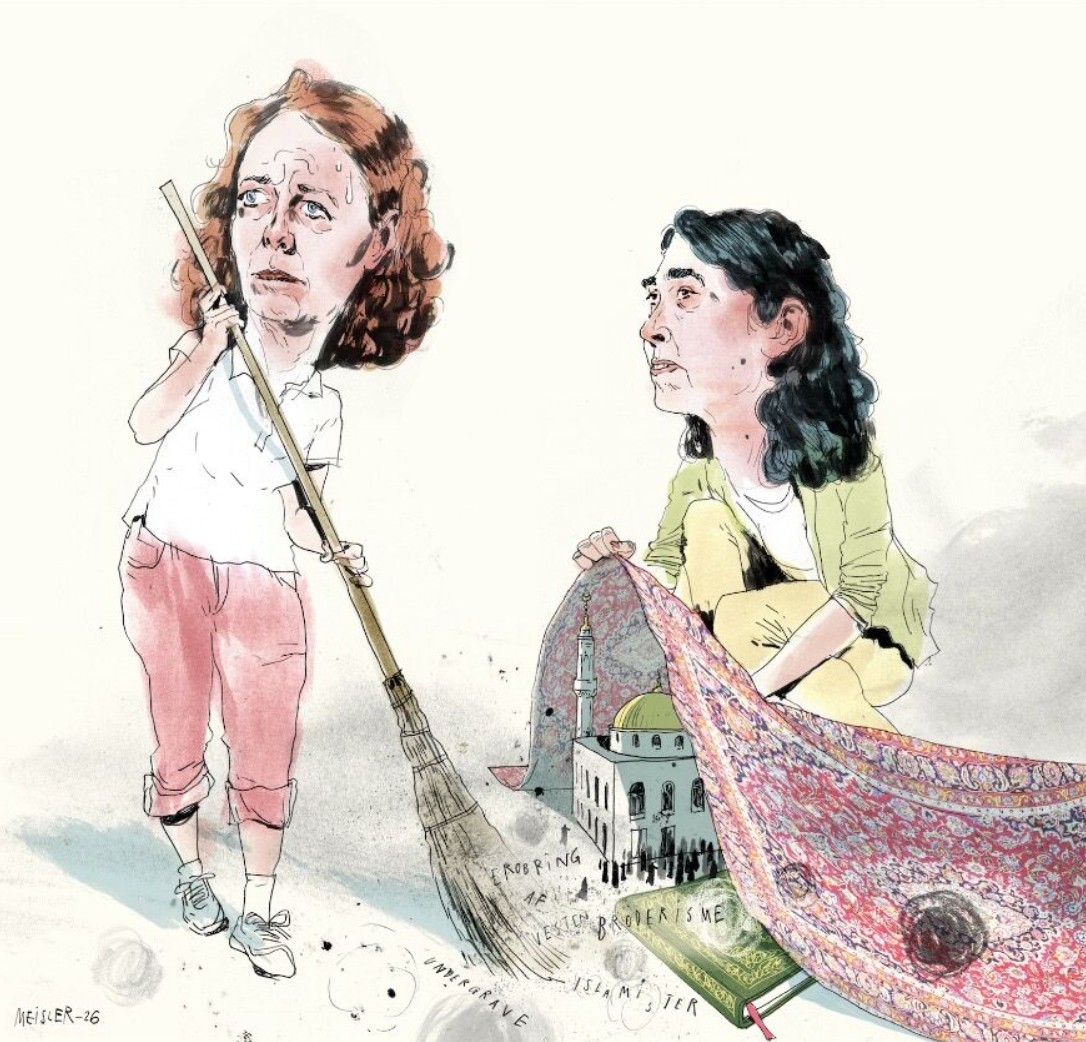
Is there, in certain fields of the humanities, a toxic intellectual climate in which disagreement on politically charged subjects is suppressed and stigmatised? Yes, and it is a serious problem, says the recently published American report Report on the State of Scholarship in the Humanities and the Humanistic Social Sciences. The report deals with the situation in the United States - but what about Denmark?
Let us examine a case that Weekendavisen has already reported on: the pillorying of Florence Bergeaud-Blackler’s book Broderismen: Sådan undergraver islamister de vestlige samfund (Brotherism: how Islamists undermine Western societies) during the winter of 2024-2025 by Professor Lene Kühle of Aarhus University and senior researcher Manni Crone of the Danish Institute for International Studies (DIIS).
In Weekendavisen, the two researchers suspected Bergeaud-Blackler of questionable research practices and claimed that she could not document her “central thesis of Islamist infiltration”. “Insane” was Lene Kühle’s peremptory verdict on the book. There is just one problem: Kühle and Crone cheat and fabricate false accusations in order to reach their conclusions.
That is what I will examine more closely in this op-ed.
In Weekendavisen, Kühle and Crone posed a series of rhetorical questions criticising the book, including this one: “Should the debate start from a book that (...) presents a central document - the smoking gun - with a manipulated quotation and without stating the source?” Framed this way, the question plants in the reader’s mind a doubt as to whether the document in question even exists.
But the document does exist. It is reproduced in the 2005 book by Swiss journalist Sylvain Besson, La Conquête de l’Occident. Le Projet secret des islamistes (The Conquest of the West: The Islamists’ Secret Project). Besson states that the document was discovered by the Swiss police in 2001 during a search of the home of Egyptian businessman Youssef Nada, a leading figure of the Muslim Brotherhood. The document is in the case file under reference nos. 4100400027-4100400040. Youssef Nada himself has confirmed the document’s existence on several occasions.
The document is a fourteen-page plan entitled Towards a Worldwide Strategy for Islamic Policy, which Besson has dubbed “the Project”. According to a confidential report by the Swiss anti-terrorism task force, the document is “a fundamental text for understanding the long-term objectives of the Muslim Brotherhood”.
It is therefore a document that everyone should know about - regardless of Bergeaud-Blackler’s book. It was seized at Youssef Nada’s home along with thousands of other documents, the sheer mass of which can inform the debate on whether Islamic normative pressure and infiltration are originally linked to an ideological and financial strategy of the Muslim Brotherhood. As Besson writes: “These documents show that the Muslim Brotherhood established a secret network in Europe over decades. The aim of this network is to serve their political ambition: the creation of a perfect Islamic society that will one day replace the West as the leading force of humanity.”
According to Besson, “the Project” is particularly important because it not only reveals “the most secret political intentions of the Muslim Brotherhood”, but also gives practical guidance on how Islamists can infiltrate Western societies.
In her book, Bergeaud-Blackler summarises the content of the document on pages 81 to 84, in her own words and through direct quotations. It is this passage that Kühle and Crone attack - without, however, engaging with the document’s overall message. In doing so, they deprive the reader of important empirical knowledge and instead fill the reader’s horizon with dubious attacks: false accusations, doctored quotations, suspicion without evidence.
I will now examine five “shaming techniques” used by Kühle and Crone - which I review in an in-depth analysis that can be downloaded from the website of the publisher Presto.
THE FIRST DEGREE lies at the “mildest” end of the shaming scale. Here Kühle and Crone use minor errors as an argument for sweeping conclusions that this type of error cannot support.
For example, when Bergeaud-Blackler inadvertently refers to Sylvain Besson’s series of articles instead of his book. But both the series of articles and the book have as their central theme how the documents seized from Nada reveal the Muslim Brotherhood’s secret plan to infiltrate and Islamise Western societies.
Bergeaud-Blackler’s error therefore cannot support Kühle and Crone’s accusation that the thesis of Islamist infiltration lacks documentation, since both sources deal with precisely that.
THE SECOND DEGREE of their shaming scale consists of straw men, which give the impression that Bergeaud-Blackler has made mistakes she has not made. For example, Kühle and Crone write of the document in question: “It is not known who wrote it.” But that is exactly what Bergeaud-Blackler herself explains. Bergeaud-Blackler writes: “Where does the document come from? The police investigators are not sure.” Bergeaud-Blackler has therefore made no mistake.
Her source, Sylvain Besson, moreover does not seem to doubt that both the author and the recipients are to be found among certain leading figures of the Muslim Brotherhood. Kühle and Crone pass over this information in silence, thereby also misrepresenting Besson’s account of the document’s significance. The two Danish researchers go on with another straw man: “it is not an official Brotherhood document.” But Bergeaud-Blackler never claims that it is.
Kühle and Crone thus bolster their case by misrepresenting Bergeaud-Blackler’s position, giving the impression that she makes mistakes she does not make. In doing so, they divert the reader’s attention away from the substance of the document that Bergeaud-Blackler presents. Kühle and Crone thereby silence essential documentation on Islamist infiltration, which is thus withdrawn from public attention.
THE THIRD DEGREE of the scale makes the matter more serious. For here Kühle and Crone begin to resort to false accusations. In her book, Bergeaud-Blackler sets out which financial networks Youssef Nada had access to according to her sources. As she writes, these financial networks were “allegedly linked not only to Al-Qaeda leader Osama bin Laden, but also to the head of the Brotherhood, Yusuf al-Qaradawi, to Hamas, to the Algerian GIA and to the Tunisian Islamist movement Ennahda”.
Kühle and Crone write of this passage: “This information is not found in the following Swiss source, note 68 (nor in the preceding note 67).” The problem is that what Kühle and Crone write is not true.
Quite the contrary.
In note 67, Bergeaud-Blackler refers to Richard Labévière’s book Les Dollars de la terreur. Les États-Unis et les islamistes, published in 1999. I consulted the English translation of 2000, Dollars for Terror: The United States and Islam. The first thing one notices is an entire chapter devoted to “The Muslim Brothers’ Holy (and Financial) War”. But the Muslim Brotherhood appears in many places in the book, not only in this chapter. As I show in my extended analysis of the case, Labévière provides abundant information confirming Bergeaud-Blackler’s claims concerning Osama bin Laden as well as Yusuf al-Qaradawi, Hamas, the GIA and Ennahda. It is therefore downright untrue to claim, as Kühle and Crone do, that this information is not in the reference given in note 67.
And what about Bergeaud-Blackler’s note 68? It refers to Sylvain Besson’s series of articles “L’histoire secrète des islamistes en Occident” (The secret history of the Islamists in the West), published in the newspaper Le Temps ahead of the release of his book. As I show in the extended analysis, this series supplements Labévière’s documentation concerning Osama bin Laden, Yusuf al-Qaradawi, Hamas and, in part, Ennahda.
It is therefore untrue to claim, as Kühle and Crone do, that “this information is not found” in the references in notes 67 and 68. Quite the contrary, since Bergeaud-Blackler’s two references, Labévière and Besson, have as their main theme precisely the investigation of these financial networks.
Particularly noteworthy is the information from Labévière and Besson on Yusuf al-Qaradawi, for many years the Muslim Brotherhood’s chief ideologue. He is widely known as an extremely influential preacher - globally as well as among Muslims in Europe. But according to Besson and Labévière, he is not merely a theorist. He is also described as the “main shareholder” of the bank and investment fund that Nada had set up in Switzerland. And that is not all. Al-Qaradawi is also said to have controlled the bank’s transactions. If this is correct, the information raises new questions about the financial means Yusuf al-Qaradawi had at his disposal to influence young European Muslims throughout the 1990s.
Kühle and Crone’s charge that documentation is missing in the two notes thus turns out to be a false accusation. But even though their accusation is untrue, it is to be expected that Kühle and Crone have succeeded in driving some readers away from Bergeaud-Blackler’s book. In a second step, this means that they also block the reader’s access to the information provided by Besson and Labévière. It is therefore no trivial lie. It is a false accusation that steers us away from the above information on the networks and financial resources of the Muslim Brotherhood in the period when it was consolidating itself in Europe. Essential information, then, if one wants to examine more closely the resources the Brotherhood had at its disposal for its project. It is this line of inquiry that Professor Kühle and senior researcher Crone undermine through their manipulation.
THE FOURTH DEGREE of the scale takes us to unexpected heights. The two Danish researchers now start altering quotations. They warn the reader against attaching any significance to the document seized from Nada. They claim that “according to Besson, it is wrong to understand the history of Islamism in its light”. But that is not what Besson writes. He writes (my emphasis in capitals): “it would be wrong to interpret the recent history of Islamism in the light of the Project ALONE.”
The word “alone” makes all the difference. It is therefore no innocent matter that Kühle and Crone pretend to quote Besson while removing the word “alone” from the sentence without informing the reader.
In Good citation practice and plagiarism in texts - guidelines, which Kühle and Crone themselves claim to follow, we read: “A number of circumstances can make a quotation unlawful. This may be the case, for example, if (...) the quotation is distorted, for example rewritten or misquoted (quotation fraud).” By their own standard of review, Kühle and Crone are thus guilty of quotation fraud, since they distort Besson’s sentence by deleting the word “alone”.
This is a falsification of decisive importance for assessing the message of Bergeaud-Blackler as well as that of Besson. Kühle and Crone make Besson’s argument sound like the opposite of what it really is. Besson in no way disputes that the document is significant for the recent history of Islamism. Quite the contrary. The whole point of his book is precisely that it is, decisively so. He explains that the document must be read in connection with all the other documents also confiscated from Nada.
The sum of the documents seized shows, according to one of the Swiss investigators interviewed by Besson, that we are dealing with an “ideology of infiltration which ultimately represents the greatest danger for European societies (...) within a decade, we will see demands for a parallel system emerge in Europe (...) then the slow destruction of our institutions will begin”.
It is therefore not only quotation fraud, but also gross manipulation on the part of Kühle and Crone when they write that “according to Besson, it is wrong to understand the history of Islamism in the light” of that document.
Once again, Kühle and Crone block the reader’s view of information that is indispensable if one wants to examine the history of the Islamic normative pressure and the examples of infiltration that we observe in Danish reality today.
THE FIFTH DEGREE of the scale is even stranger. Here Kühle’s imagination runs completely wild. She does not merely brush aside the document’s significance. In an interview with Weekendavisen, she warns that it is “disputed” whether the document is authentic or a forgery. But Kühle does not document who disputes its authenticity. Nor does Kühle say whom she suspects of having forged it. Is it Sylvain Besson she is accusing of forgery? One of Switzerland’s most respected investigative journalists. He received the prestigious Swiss Press Award in 2017 for his journalism, has nearly thirty years of experience covering economic crime and hidden networks, and is also a former editor at the daily Le Temps. If Kühle believes that a journalist of this calibre has forged raw journalistic material, she ought to inform the Swiss public.
Or is it one of the Swiss police investigators whom Kühle suspects of having forged a document confiscated during a search? Under Article 317 of the Swiss Criminal Code, forgery of documents by a public official is punishable by up to five years. If Kühle has evidence to that effect, why has she not reported it? Is it because she knows full well that the suspicion of “forgery” is her own invention?
FLORENCE BERGEAUD-BLACKLER’S BOOK on Brotherism was met in the Danish debate with reputation-destroying accusations from Lene Kühle and Manni Crone. Accusations liable to drive readers away from the book. Kühle and Crone chose not to debate the book’s argument, but to pillory Bergeaud-Blackler by resorting, among other things, to false accusations and doctored quotations.
This does not mean that there are no errors in her book Broderismen. There are a few errors and, unfortunately, a number of careless mistakes. These errors must of course be corrected in future printings. But the errors and inaccuracies that can be identified do not invalidate the documentation found in the sources to which Bergeaud-Blackler refers.
The problem is that Kühle and Crone have intervened in the public debate in a way that blocks our access to these sources, and that gives the public the impression that the examples of Islamic normative pressure and infiltration given by Bergeaud-Blackler are merely a product of her imagination. It is not unrealistic to assume that Kühle and Crone have thereby prevented the Danish public from understanding certain factors that may lie behind the Islamic normative pressure observable today in European welfare societies.
This therefore concerns us all, and that is why we cannot leave it at that.
We are compelled to ask what the consequences are when certain research communities pillory dissenters such as Bergeaud-Blackler. According to the Report on the State of Scholarship in the Humanities and the Humanistic Social Sciences, this ideologisation strikes at “the very foundation on which a university should rest”. Namely, the possibility of an objective and sober examination of all the sources that can shed light on a given question.
In this case, Kühle and Crone have not only broken the most fundamental rules of honesty and objectivity in research. They have also attacked the very foundation of our public conversation. We must be able to trust what a researcher says. It is this trust in research that Kühle and Crone undermine. Neither the public nor research benefits from this, and it must not happen again.
We therefore need a more principled discussion of how we will ensure the quality and credibility of publicly funded research in the future.
Tina Magaard, PhD, former postdoctoral researcher at Sorbonne-Paris IV and former associate professor at Aarhus University
Lene Kühle and Manni Crone have been presented with the criticism set out in this op-ed, but have not wished to respond.
Commentary by Florence Bergeaud-Blackler
The case set out in the following text is not a matter of simple academic disagreement. It concerns the public impugning of a researcher’s scientific integrity and her disqualification by means of particularly serious false accusations: plagiarism, appropriation of other people’s work, manipulation or fabrication of quotations, “inventions”, distortion of sources and, more generally, research practices presented as contrary to “academic standards”.
In the world of research, criticising a hypothesis, challenging an interpretation, pointing out an error or discussing the quality of a source is part of the normal functioning of science. Accusing a researcher of plagiarism or scientific dishonesty is something else altogether. It is no longer the validity of an argument that is being challenged, but the professional integrity of its author and, by extension, the reliability of all of their work.
These accusations have just been recognised as unfounded.
Having been accused and now cleared, I recount the unusual details of an affair that targeted me personally and, beyond me, a field of research that some are seeking to censor: work on the Muslim Brotherhood in Europe.
Chronology of the accusatory mechanism
The controversy began in Denmark in the summer of 2024 around Broderismen, the Danish translation of my book Le Frérisme et ses réseaux, published in 2023 by Odile Jacob, with a foreword by the Danish researcher Thomas Hoffmann.
On 31 July, Manni Crone, a researcher at the Danish Institute for International Studies, published a harsh critique of the book in the newspaper Altinget, criticising it in particular for insufficient documentation and generalisations about Muslims.
I replied publicly on 3 August in the same newspaper, challenging her arguments, pointing out what I considered to be misreadings and regretting that the debate was shifting from academic discussion to an attempt at personal delegitimisation.
At that point, heated as it was, I did not for a moment believe that this attempt at delegitimisation would continue.
I was wrong. As early as August, I learned from an email from Thomas Hoffmann, who wrote the book’s foreword, that very serious accusations of plagiarism and poor academic practice against me were circulating in Danish academic circles. These suspicions had reportedly been circulating for several months, creating a climate of suspicion around the book and its author. I did not know what the charges were and therefore could not respond to them.
During a stay in Denmark between October and November 2024, when I had been invited, among other things, to a conference to present my book, my detractors Lene Kühle and Manni Crone attended the event. They did not come forward to present their criticisms to me. Lene Kühle had declined to take part in the conference panel to which she had been invited.
It was not until 15 November 2024 that a journalist named Kasper Schøler Fast, from the daily Berlingske, asked me to respond to these criticisms. He formally sent me the accusations developed by Lene Kühle and Manni Crone and attached to his message a document of some thirty pages and an Excel file of some 340 lines listing problems in the book, announcing no fewer than 600 quotations and notes deemed faulty. The whole package was wrapped in comments from a third academic, Sten Schaumburg-Müller, a professor and member of a committee on academic practice. He gave his opinion on certain examples on the basis of the dossier compiled by Kühle and Crone, while specifying - the man is honest - that he had not examined the book directly… Which did not prevent him from highlighting alleged copyright violations and “scientific dishonesty”.
Kühle and Crone spoke of massive irregularities and of such confusion in the references that it would become almost impossible, they said, to verify certain claims. It is true that they had their students work for weeks tracking down the slightest misplaced comma; no doubt they had some difficulty synthesising all of it. The authors of the dossier, clearly wishing to inflate the damage, also claimed that the problems affected every chapter and that many more examples could be found if the whole book were examined in greater depth.
This impression of sheer volume helped shift the debate from a discussion of isolated errors to the idea of a general failure of method and, ultimately, to that of possible “scientific misconduct”. Denmark was the world pioneer in the institutional regulation of research integrity, creating the first national body dedicated to the subject as early as 1992. The Danish Board on Research Misconduct (DBRM) handles serious misconduct cases centrally. When misconduct is established in Denmark, the official verdict leads to the retraction of fraudulent publications, professional sanctions up to and including the researcher’s dismissal, and the cutting off or repayment of funding. The researcher’s career is ruined. But for that, the dossier has to be heavy, and that is what the two Danish researchers would set about fabricating from scratch.
I shuddered on receiving this email announcing 600 errors. How could that be? I was quickly reassured on reading the arguments.
A careful reading of the Excel table revealed very serious flaws. Several entries stemmed from the same problem: a pagination error or an imperfect reference reproduced many times over. In addition, typographical errors and translation flaws were counted, thus lumping together anomalies of entirely different kinds. Yet a simple error does not constitute fraud; it is rather a typo. A badly reproduced bibliographical reference cannot be described as data fabrication. Likewise, a divergent interpretation of a source is not falsification, and an isolated paraphrase - provided it is duly sourced - is not plagiarism.
Describing a piece of work as scientific misconduct requires rigorous proof. One cannot simply pile up anomalies by judging them against the standards of peer-reviewed journals. Those journals do not have the same requirements as a book published by a commercial publisher, whose chief concern is not to weigh down the narrative with overly standardised citations.
Despite the particularly short deadline I was given to respond - three days and three nights including a weekend - on 17 November I sent the journalist a ninety-six-page document answering each of the allegations point by point. In it I argued that the announced number of errors was artificially inflated, that a large proportion of the items listed were minor or formal errors that could be corrected in a reprint, and that several more serious accusations were factually unfounded.
On 21 November, the Berlingske journalist, who had had my ninety-six-page reply examining the accusations point by point since 17 November, sent me a new version of his article. I found that several accusations and wordings to which I had already responded with corrections and supporting evidence had been kept. Despite another deadline cut to half a day, while I was travelling for academic work, I pointed out the passages I considered false or ambiguous and recalled the evidence contradicting them. I vigorously contested the retention of a false accusation of plagiarism. I demonstrated - an extremely serious fact - that the sentence had been falsified by the two Danish professors to make it look like plagiarism.
I also pointed out that Lene Kühle’s claim that we had worked together on a project devoted to Islamism was false, and I provided the supporting evidence.
I acknowledged the following errors in the book translated into Danish:
12 incomplete or missing references;
6 typos and misprints;
66 academic standardisation issues that are not considered a problem in a commercial edition;
5 factual errors;
2 translation and contextualisation errors;
2 problems with diagrams and links.
These errors have no impact on the book’s argument.
The analysis of the Excel table that I sent to the journalist shows that out of 249 critical comments, 186 (74.7 %) concern only missing page numbers. To which must be added 61 quotations from a focus group counted as faulty, even though the methodology, date, conditions and funders are set out at the head of the chapter. And so I expected, fairly calmly, that the journalist would do his own investigation and that the affair would deflate like a balloon.
At that stage, as I saw it, the journalist ought to have pursued his investigation, examined the way in which the accusatory dossier had been produced - notably with the participation of several students - and questioned Kühle and Crone’s quality control. The questions the journalist should have been asking at that stage were: who identified the problems? With what expertise? Following what instructions? Who checked them? How did one get from the possible observation of an anomaly, or its production, to its characterisation as plagiarism, invention or scientific misconduct?
Nothing of the sort. On 18 November, the journalist - who probably did not understand much of it, did not want to risk antagonising Danish academics, and preferred to sacrifice a foreign researcher - forwarded my replies as they stood to the two researchers without my consent. Another version then reached me, considerably toned down, but containing old and new false allegations.
The version finally published by Berlingske still contained this “suspicion of plagiarism”. An extremely disparaging judgement from another academic - presenting my work as a “conspiracy theory” - was also added.
Moreover, the text referred to the two professors’ full accusatory document, which they had published on the official website of Aarhus University, giving this dossier extraordinary visibility and a lasting institutional footprint.
I could not believe my eyes. The false accusatory dossier was now institutionalised and liable to be picked up by journalists, academics, publishers, recruiters, institutions or funders without their being aware of my replies. This kind of accusation can affect colleagues’ trust, scientific collaborations, invitations to universities, publications, translations, funding and, more generally, an entire academic career.
Of course, I know that these subjects are riven by political, ideological and scientific conflicts. I know that the actors studied sometimes contest the categories used to describe them; researchers themselves differ profoundly as to the relevant concepts, the nature of the networks, their degree of structuring or the interpretation of their strategies. These disagreements are legitimate. But there is a fundamental difference between contesting an analytical category and disqualifying; between refuting an argument and casting suspicion on the integrity of its author; between showing that a source does not support a conclusion and accusing the researcher of “manipulation”; between showing that a reference is wrong and inferring from it a systemic practice of falsification.
This is where the whole affair goes beyond me personally.
For if a controversy about a sensitive subject can be turned into an accusation of professional misconduct without sufficiently robust proof, the consequences affect the very object of research (Brotherism, or legalist Islamism). Researchers and students will soon learn that certain subjects carry not only an intellectual risk, but a reputational and professional one.
Scientific self-censorship does not necessarily stem from an explicit ban. It can result far more effectively from anticipating the consequences of a piece of research. An accusatory dossier of this kind, full of errors and insinuations, however false it may be, is dissuasive enough for anyone who wants to work on this sensitive subject. I am not even talking about the personal safety of researchers on a subject that can cost you your life. We know this in France with Professor Paty. I am, incidentally, still under 24/7 police protection, and this affair has not helped matters, since it has moved to France.
The affair goes international and reaches the French daily Le Monde
On 14 February 2026, the affair took a new turn in France. Le Monde published an article by Youness Bousenna entitled “Florence Bergeaud-Blackler, l’anthropologue twitteuse qui embarrasse le monde académique” (Florence Bergeaud-Blackler, the tweeting anthropologist who embarrasses the academic world).
This hostile portrait explicitly repeats the accusations made in Denmark by Lene Kühle and Manni Crone. The Danish dossier thus became one of the elements used by the major French daily to call my scientific integrity into question [Le Monde, 14 February 2026].
The passage devoted to their criticisms names them expressly: “Lene Kühle and Manni Crone argue that the work contains numerous problems of scientific rigour”. It lists inaccuracies in transcription, erroneous factual information, poor referencing and broken hyperlinks, then mentions more serious failings, notably suspicions of plagiarism, distorted quotations and undocumented claims. It concludes: “In all, 95 ‘problematic practices’ are reported for this book of just over 400 pages”.
Another real hodgepodge of figures.
Le Monde juxtaposes editorial flaws and accusations bearing on scientific integrity, then groups them under a total whose composition and significance the reader cannot assess. And it does not mention my reply to the Danish dossier. The accusations circulate and gain new visibility in France, where readers are aware neither of the accusatory dossier nor of these falsifications.
This is not Le Monde’s first attempt against me, as I explain in La Nouvelle Revue Politique, in a reply entitled “Quand Le Monde fait le procès d’une anthropologue menacée de mort” (When Le Monde puts an anthropologist under death threat on trial) (La Nouvelle Revue Politique, 15 February 2026).
Introduction to Tina Magaard’s op-ed
If I am returning to this sequence of events today, it is because a new op-ed by Tina Magaard has just been published in the Danish newspaper Weekendavisen, dated 11 September 2026.
Entitled “Sous le tapis des chercheurs sur l’islam” in its French translation (Under the rug of the Islam researchers), it examines the way in which Lene Kühle and Manni Crone constructed several of their accusations against my book. A former associate professor at Aarhus University, Tina Magaard takes up the incriminated passages, consults the sources to which I refer and compares their content with my critics’ claims.
In the face of these attacks, Magaard’s analysis sets out a relentless textual counter-expertise that demolishes my accusers’ methodology. Far from nebulous theoretical debates, this rebuttal confronts their allegations directly with the realities of the text in order to dismantle two mechanisms of sheer bad faith: grotesque disproportion and a crude attribution of intent. Her demonstration of material rigour catches my accusers in their own trap: it provides objective proof that they deliberately misread, truncated and over-interpreted my work in order to fabricate an accusation of misconduct out of thin air. The aim was to silence me and, beyond me, to silence the study of Islamism. For I am not the only one they want to silence, as Jean Chichizola showed in an article in Le Figaro entitled “‘On ne peut plus travailler, sauf à prendre des risques’: ces chercheurs pris pour cible par les islamistes” (“We can no longer work without taking risks”: the researchers targeted by Islamists), published in June 2025.
“The smoking gun” by Tina Magaard
When a professor and a senior researcher cheat, manipulate and fabricate false accusations
Editor’s note. In her op-ed, Tina Magaard refers to an in-depth analysis of Lene Kühle and Manni Crone’s accusations, published by Pressto. We reproduce below its English translation, made from the French translation. The original version, in Danish, is available on the publisher’s website: forlaget-pressto.dk/images/The-smoking-gun-Broderismen.pdf
Notice concerning Lene Kühle and Manni Crone’s attack on the book Broderisme. Sådan undergraver islamister de vestlige samfund (Brotherism: How Islamists Undermine Western Societies) by Florence Bergeaud-Blackler (Pressto, 2024).
Translation note. Passages from Broderismen quoted here are given from the Danish edition: their translation into English does not reproduce Florence Bergeaud-Blackler’s original text. Quotations from Sylvain Besson are translated from their original French wording where the notes to the Danish text provide it. Quotations from Richard Labévière are translated from the French rendering of the English edition (Dollars for Terror, Algora, 2000), the only edition consulted by the author of the notice; they may differ from the wording of that edition.
Berøringsangst (“Fear of contact”) is the title of a recently published book documenting how teachers, social workers, nurses and other public employees find themselves, in their daily work, checkmated by colleagues who seek to promote an Islamist agenda within society’s core institutions. From within.
But what patterns of thought underlie this Islamic normative pressure? Why has research not long since given us the tools to decode it?
Weekendavisen has previously published a story that is highly relevant in this respect: in her book Broderisme: Sådan undergraver islamister de vestlige samfund, the French researcher Florence Bergeaud-Blackler tried to convey an understanding of these patterns of thought. But Professor Lene Kühle of Aarhus University and senior researcher Manni Crone of DIIS attacked the book, accusing it of being unable to document its “central thesis on Islamist infiltration”.
Berlingske asked me to comment on the case. However, I did not want to express a view before I had had time to examine it. I have now done so.
From my very first reading of Kühle and Crone’s investigation, alarm bells started ringing. Several of the references, both to Broderismen and to other works that Kühle and Crone claim Bergeaud-Blackler misuses, did not add up. So I obtained the sources to which they refer in order to go through their claims with a fine-tooth comb. As the work progressed, one thing became ever clearer: Kühle and Crone cheat, manipulate and fabricate false accusations in order to reach their conclusions.
The so-called “smoking gun” example appears to be one of the most important pivots of Kühle and Crone’s criticism of Bergeaud-Blackler. It should be noted here that “the smoking gun” is not an expression FBB uses herself; flashy phrases of that kind are not her style. It is Kühle and Crone who use it, in an interview with Weekendavisen, where they ask the following rhetorical question:
“Should the debate take as its starting point a book that (…) presents a central document - the smoking gun - with a manipulated quotation and without stating the source?”1
When KC present things in this way, readers may come to doubt whether the central document even exists. Where did Bergeaud-Blackler get it from?
The document is reproduced in the book by Swiss investigative journalist Sylvain Besson, La Conquête de l’Occident. Le Projet secret des islamistes, published in 2005.2 In my view, it is a document everyone should know about, regardless of the footnote quarrel between Bergeaud-Blackler and KC. It is indeed one of many documents that can shed light on the question of whether Islamic infiltration of European welfare societies is originally linked to a practical and financial strategy of the Muslim Brotherhood.
The history of this document is striking. In the wake of 9/11, an Islamic bank and investment fund called al-Taqwa was suspected of having been involved in financing al-Qaeda terrorism. The Swiss police therefore carried out a search at the home of the bank’s head, Youssef Nada, a leading figure in the Muslim Brotherhood. Not enough evidence was found to bring proceedings for direct terrorist financing. But something else was found. As Besson writes:
“On the evening of 7 November 2001, the investigators left Campione with lorry-loads of documents. They show that the Muslim Brotherhood has, for decades, built an underground network in Europe serving its political ambition: the creation of a perfect Islamic society which will one day supplant the West as the guiding force of humanity.”3
Among the thousands of documents the police found during the search of Nada’s home is the one to which FBB refers. It is a fourteen-page text in Arabic entitled Towards a Worldwide Strategy for Islamic Policy (Points of Departure, Elements, Procedures and Missions).4 Besson’s book uses the shorter title The Project, which I will also use here. According to Besson, this document is important because it reveals “the most secret political intentions of the Muslim Brotherhood”5, and because it gives practical guidance on how to infiltrate Western societies. Anyone wishing to take part in the debate on whether there is targeted Islamist infiltration of our societies needs to know this document, regardless of the footnote quarrel between Bergeaud-Blackler and KC.
But let us return to Bergeaud-Blackler’s book, Broderismen: Sådan undergraver islamister de vestlige samfund. How does she treat this important document? She examines it on pages 81 to 84 (pages reproduced here).
Bergeaud-Blackler first presents the context of the search of Nada’s home, then narrows the focus to the Project. She does not reproduce the Project in full, which runs to fourteen pages in Besson. Instead, FBB chooses to devote about two pages to summarising the points of the Project she considers most important: that the ultimate goal, an Islamic state, is to be achieved through a (bold added by me) “gradual effort” aimed, “through institutional work”, at gaining “control of local centres of power”. The document calls for selecting areas where “Islamic power” is to be established. More concretely, it calls for setting up “specialised Islamic economic and social institutions”. At the same time, “temporary cooperation must be established between Islamic movements and national movements”, for example “in the anti-colonial struggle and in the struggle against the Jewish state”. Finally, it recommends “enjoining what is right and forbidding what is wrong”6 (= exercising Islamic normative pressure). These quotations are taken directly from the Project as it appears in Besson’s book. I double-checked them, both against Bergeaud-Blackler’s original French text and against Besson’s book.
Bergeaud-Blackler presents this document from Sylvain Besson’s book as one piece of evidence among many pointing in the same direction: namely, that the Islamic normative pressure observable in Europe today can be linked to the strategic and economic effort to promote Islamic infiltration launched by the European network of the Muslim Brotherhood almost half a century ago.
What is Kühle and Crone’s position on this? They pass over the document’s overall message in silence and thus deprive the reader of empirical knowledge that is important for the discussion of Islamic infiltration. Instead, Kühle and Crone choose to saturate the reader’s horizon with their attacks on this passage of the book. It is these attacks that we will examine below. They fall into the following categories:
- KC use minor errors as a pretext for sweeping conclusions that this type of error cannot support.
- KC misrepresent Bergeaud-Blackler’s position, thereby giving the impression that she has made mistakes she has not made.
- KC fabricate false accusations against Bergeaud-Blackler.
- KC cheat with a decisive quotation from the primary source.
- KC cast doubt not only on Bergeaud-Blackler’s credibility, but also on that of Besson and the Swiss investigators, by suspecting, without the slightest shred of evidence, that the Project is a “forgery”.
One has to be careful here, because we must distinguish between sentences belonging to one of the following three categories:
- Quotations from FBB and Besson. These are marked in bold.
- KC’s attacks on Broderismen. These are marked by underlining.
- My critical examination of the soundness of KC’s attacks. Unmarked.
1. KC use minor errors as a pretext for sweeping conclusions that this type of error cannot support
Some of the errors KC point out are real and should be corrected in future editions. They are, however, typically minor formal errors. The problem is that KC use these errors as a starting point for sweeping conclusions that this type of error cannot support.
EXAMPLE 1
In their investigation, KC present the following table, drawn from their examination and diagnosis of FBB’s errors:
| Passage targeted | KC’s comment | Classification |
|---|---|---|
| pp. 81-83. “The document, which is written in Arabic, consists of twelve points and begins as follows.” (p. 81) Note 68. | The quotation from the document mentioned is not found in the source given, note 68 (a series of articles by Sylvain Besson in a Swiss newspaper). It turns out to come from Besson’s book La conquête de l’Occident (2005, p. 193). FBB changes the translation of the quotation given by Besson, replacing the word “god” with “Allah”. In FBB’s rendering, the 12 points become 13, and the relationship between the content of the document’s 12 points and FBB’s 13 points is hard to make out. Not all the quotations are found in Besson’s book (2005), which is not mentioned. As the “summary” mixes text with and without quotation marks, it is also difficult to discern what is quotation, what is paraphrase and what is FBB’s own interpretation. An isolated example of carelessness in quoting the document is reproduced immediately below. | Carelessness/manipulation of quotations and source. Incorrect reference. |
In the first column, they quote the passage of FBB’s book that they attack: “The document, which is written in Arabic, consists of twelve points and begins as follows.” Note 68.
In the second column, they explain where, in their view, the problem lies: “The quotation from the document mentioned is not found in the note 68 given.”7 In the third column, they classify the type of error as “carelessness/manipulation of quotations and source” and “incorrect reference”.
Is what KC write right or wrong? Which work does FBB refer to in note 68? She refers to Sylvain Besson’s series of articles “L’histoire secrète des islamistes en Occident (1/6). Les secrets d’Al-Taqwa, la banque suisse de l’islam radical”, Le Temps, 2005.8
KC are right on one point: the document quoted is found in Besson’s book, not in his series of articles. FBB thus credits the right author (Sylvain Besson), but ends up referring to his series of articles instead of his book.
How serious is this error? Two remarks are called for.
REMARK 1. First, KC fail to inform the reader that both the series of articles and the book deal with the thousands of documents the police took away during the search of Nada’s home in 2001. The purpose of the series of articles is to arouse the reader’s interest in the book, since it was published ahead of the book’s release and each article in the series ends with a reference to the book. The central theme of both the book and the series of articles is how the documents seized from Nada reveal the Brotherhood’s secret plan to infiltrate and Islamise Western societies. The book and the series of articles are therefore closely linked thematically, and the series of articles leads the reader to the book. Bergeaud-Blackler’s oversight is therefore not enough to support KC’s accusation that the thesis of Islamist infiltration lacks documentation, since both sources document precisely that.
REMARK 2. The question is how serious Bergeaud-Blackler’s error is when judged by KC’s own standard of review. In God citatskik og plagiat i tekster (“Good citation practice and plagiarism in texts”), which KC claim to follow, we read: “The author’s name must always be given when quoting. In addition, at least the title and the publisher/medium should be given.”9
It can be argued here that FBB gave what is mandatory - the author’s name - but not what is recommended - the title and publisher of Besson’s book. My assessment is that, even though FBB formally meets the “must” requirement laid down by KC’s standard of review, she would have been well advised also to meet the “should” requirement as regards citing the correct work. If only to prevent exactly what is happening here: the form being attacked in order to divert the reader’s attention from the empirical material which, according to Besson, “shows that the Muslim Brotherhood has, for decades, built an underground network in Europe serving its political ambition”.10
Who helps us best to understand what empirical material exists concerning this “political ambition” to infiltrate Western societies?
Bergeaud-Blackler takes us a good part of the way, since she reports information drawn from Besson’s series of articles and book. But she also puts a spoke in our wheels: by omitting the reference to the book, she makes it harder to access the primary source that we would like to know about independently of her own book.
KC, for their part, trip us up in my view far more seriously, since they exploit Bergeaud-Blackler’s carelessness to lead us away altogether from the documentation on the Brotherhood’s infiltration effort presented by Sylvain Besson. They thereby considerably curtail our ability to bring the relevant empirical material into the discussion of the experiences of infiltration and Islamic normative pressure that certain citizens in Denmark are living through today - for example, professionals in the social sector.11
EXAMPLE 2
KC also use the fact that FBB referred to Besson’s series of articles rather than his book against her in assessing the sentence below, without informing the reader that they are using this one and the same footnote error to attack two sentences.
On page 82 of Broderismen, we read:
“The document, which [is] addressed to the supreme leadership of the Brotherhood, appears to have been written in deliberately vague language, as if to anticipate that it might fall into the wrong hands. It is a kind of roadmap, designed to communicate initial instructions.”12
On this point, KC assert that “the claim (…) appears undocumented”.13 Formally, they are right. There is no documentation for this precise sentence in the series of articles by Besson to which FBB refers, but there is in Besson’s book. Since KC know the book and refer to it themselves, they should have pointed out to us that this is where FBB draws her information from. If we break FBB’s sentence down into three, we can see the following:
a) “The document (…) [is] addressed to the supreme leadership of the Brotherhood” is a paraphrase of Besson’s assessment that the document is “reserved for the ruling elite of the Muslim Brotherhood”.14
b) That the document “appears to have been written in deliberately vague language, as if to anticipate that it might fall into the wrong hands” is Bergeaud-Blackler’s own assessment, which she moreover signals with the word “appears”. It is an assessment one may or may not agree with, but I would not call it an error. Kühle and Crone themselves make use of this kind of assessment, with which the reader may or may not agree. Kühle writes, for example, in Danmarks moskéer: mangfoldighed og samspil, that “the construction of this prominent mosque appears to have functioned as a reminder to the rest of society of the presence of Shia Islam”.15 Similarly, Crone writes in her article Hjemmedyrket terrorisme trussel eller skrøne that “the Vollsmose case of 2006 and the Glostrup case of 2005 appear to have been cases of open source terrorism”.16 Neither Kühle nor Crone gives a note or reference for these assessments. But if Kühle and Crone believe that Bergeaud-Blackler should refer to documentation for her assessment, they are applying a stricter formal standard to Bergeaud-Blackler’s popular book than to their own scholarly publications. Why? It is for them to explain.
c) “It is a kind of roadmap, designed to communicate initial instructions.” Bergeaud-Blackler borrows the expression “roadmap” (“feuille de route”, in French in the text) from Besson’s book, where it is used by one of the investigators he quotes.17
Since KC know Besson’s book, they should have pointed out that the documentation for Bergeaud-Blackler’s claims is found in Besson’s book, not in the series of articles to which Bergeaud-Blackler refers in note 68. They do not. Instead, they give the reader the impression that we have here yet another example of claims by Bergeaud-Blackler for which no documentation exists.
EXAMPLE 3
In this third example, KC once again reuse the single footnote error, the one where Bergeaud-Blackler refers only to Besson’s series of articles and not to his book. They attack a sentence whose information is drawn from both the series of articles and the book. Bergeaud-Blackler writes:
“The financial network is allegedly linked not only to al-Qaeda leader Osama bin Laden, but also to the head of the Brotherhood, Yusuf al-Qaradawi, to Hamas, to the Algerian GIA and to the Tunisian Islamist movement Ennahda.”18
KC again accuse Bergeaud-Blackler of “lack of documentation”, writing: “Nothing is said about either the GIA or Ennahdha.” But the GIA and Ennahda are mentioned in Besson’s book, pp. 160 and 163.19 The rest of the information is in the series of articles to which FBB refers (see the section below, “KC fabricate false accusations against Bergeaud-Blackler”).
How did KC influence the debate?
Had KC chosen to give the public access to as much information as possible about Islamic infiltration, they would have told us that Bergeaud-Blackler, in note 68, refers only to Besson’s series of articles and not to his book, but that the information not found in the series of articles is indeed in the book.
Had they done so, the consequence for the public debate would probably have been that we would have discussed the content of the Project, and the question of whether its ideas may have had a bearing on the Islamic infiltration of today’s European welfare societies. Readers wishing to go further could have read Bergeaud-Blackler’s book and supplemented it with Besson’s work - both the series of articles and the book.
But KC choose a method that instead blocks the reader’s access to the valid information on the Islamic infiltration of European welfare societies presented by Besson. They hijack Bergeaud-Blackler’s single footnote oversight to derive three separate accusations from it, according to which Bergeaud-Blackler’s information - and therefore Besson’s - is “undocumented”. How might this have influenced the debate?
It is reasonable to imagine that KC thereby led the reader to believe that Bergeaud-Blackler has no documentation for the thesis of Islamist infiltration, but that it is instead a conspiracy theory she invented herself. That will lead any self-respecting reader to flee the debate and, moreover, to keep well away from both Broderismen and its sources. The result is a truncated debate, since KC have thereby silenced essential documentation on Islamist infiltration, which is thus withdrawn from public attention.
2. KC misrepresent Bergeaud-Blackler’s position, thereby giving the impression that she has made mistakes she has not made
In their investigation, in the section “Documentation problems/use of sources”, KC attack Bergeaud-Blackler’s use of the document The Project with the following arguments:
1) “It is not known who wrote it.”20 But that is precisely what Bergeaud-Blackler herself explains. She writes: “Where does the document come from? The police investigators are not sure.”21 FBB has therefore made no mistake. Besson, moreover, does not appear to doubt that both the author and the recipients are to be found among leading figures of the Muslim Brotherhood.22 KC withhold this information, thereby also misrepresenting Besson’s account of the document’s significance.
2) “It is not an official Brotherhood document.”23 But Bergeaud-Blackler never claims that it is.
3) “The source itself is not about Osama bin Laden, but about one of his “lieutenants”, and the lead was abandoned for lack of sufficient documentation.”24
Yet Bergeaud-Blackler does not claim that the source is about bin Laden. Quite the contrary. Bin Laden appears only on page 81, in the subordinate clause “an international offensive against the Brotherhood, suspected of being linked to the al-Qaeda movement”, and, a little further down the page, where FBB writes that “the financial network is allegedly linked not only to al-Qaeda leader Osama bin Laden, but also to the head of the Brotherhood, Yusuf al-Qaradawi, to Hamas, to the Algerian GIA and to the Tunisian Islamist movement Ennahda”.25 These passages faithfully reflect the way in which the areas of contact between al-Qaeda and the various branches of the Muslim Brotherhood are presented in Besson’s texts26, as well as in the other source cited by Bergeaud-Blackler, namely Labévière’s Les Dollars de la terreur. Les États-Unis et les islamistes.27
As these three examples show, KC strengthen their case-building by misrepresenting Bergeaud-Blackler’s position, thereby giving the impression that she makes mistakes she has not made.
3. KC fabricate false accusations against Bergeaud-Blackler
On page 81, FBB provides essential background information on the Project. To understand the possible striking power of the Muslim Brotherhood’s supreme leadership in carrying out the strategy set out in the Project, it is necessary to take into account the financial networks to which Youssef Nada and al-Taqwa have access. Bergeaud-Blackler writes:
“The financial network is allegedly linked not only to al-Qaeda leader Osama bin Laden, but also to the head of the Brotherhood, Yusuf al-Qaradawi, to Hamas, to the Algerian GIA and to the Tunisian Islamist movement Ennahda.”28
The table below shows what KC write about this quotation. Note how KC distort the quotation in the first column:
| Passage targeted | KC’s comment | Classification |
|---|---|---|
| p. 81, about a document intercepted by the Swiss police in 2001 as “linked not only to al-Qaeda leader Osama bin Laden, but also to the head of the Brotherhood, Yûsuf al-Qarâdâwi, to Hamas, to the Algerian GIA and to the Tunisian Islamist movement Ennahdha” (p. 81) | Information requiring documentation, but no source given. These elements are not found in the following Swiss source, note 68 (nor in the preceding note 67). The source itself is not about Osama bin Laden, but about one of his “lieutenants”, and the lead was abandoned for lack of sufficient documentation. Nothing is said about either the GIA or Ennahdha. | Lack of documentation. Carelessness with the source. Addition of information not found in the source given. |
In column 1, KC make it sound as though FBB writes that it is the document that is linked to the network. But that is not what FBB writes, as can be seen from the quotation at the top of the page. She is writing about the FINANCIAL NETWORK of which Youssef Nada was a part.
And it gets worse. Building on their alteration of FBB’s quotation, KC make a series of false accusations:
- “no source given”
- “These elements are not found in the following Swiss source, note 68 (nor in the preceding note 67).”
- “Lack of documentation”
- “Addition of information not found in the source given.”
All four of these charges are false.
KC write “no source given”, but this is not true. Notes 67 and 68 give two sources from which FBB draws her information:
Note 67. On Islamist financing and the links between peaceful and violent Brothers, see R. Labévière, Les Dollars de la terreur. Les États-Unis et les islamistes, Paris, Grasset et Fasquelle, 1999, pp. 156-160, and https://blogs.mediapart.fr/danyves/blog/300817/et-revoila-les-dollars-de-la-terreur
Note 68. The information comes from a series of articles written by the Swiss investigative journalist Sylvain Besson, “L’histoire secrète des islamistes en Occident (1/6). Les secrets d’Al-Taqwa, la banque suisse de l’islam radical”, Le Temps, 2005 (available online, see articles 1/6 and 3/6).
Nor, therefore, is it true when KC paraphrase themselves three times, adding “lack of documentation”, or “These elements are not found in the following Swiss source, note 68 (nor in the preceding note 67)”, or “Addition of information not found in the source given”.
I will now go through the two sources FBB cites and check what support she finds in them for her claim.
3a) What does the reference in note 68 say?
Note 68 refers to Sylvain Besson’s series of articles, “L’histoire secrète des islamistes en Occident”, which Besson published in the newspaper Le Temps as a foretaste ahead of the release of his book.29 Does Besson’s series of articles contain evidence of financial links between al-Taqwa, bin Laden, al-Qaradawi, Hamas, the GIA and Ennahda?
Al-Qaradawi is mentioned 17 times in the series of articles.30 According to Besson, he is “one of the main shareholders of al-Taqwa”. The financial link that FBB highlights in the quotation above is therefore documented by Besson. Al-Qaradawi also appears on a videotape showing him, together with al-Taqwa representative Ali Ghaleb Himmat, on a tour of Afghanistan. See the entry below on Ali Ghaleb Himmat.
Ali Ghaleb Himmat appears 10 times in the series of articles31, and is linked both to al-Qaeda and to al-Qaradawi by a videotape found during the search of Nada’s home. The video comes from a trip to Afghanistan, where Himmat stayed in the area around the al-Qaeda base near Lake Derunta. In a hotel in Jalalabad, Himmat is seen meeting a delegation from the Brotherhood’s supreme leadership: the preacher al-Qaradawi and Mustafa Mashhur (Supreme Guide of the Brotherhood from 1996 to 2002). The tape also shows Mashhur giving a speech in Kabul, rallying people to fight “the enemies of Islam”, and concluding: “I assure you that, just as the Soviet Union collapsed, so the United States and the West will succumb, with God’s help.” Besson’s comment is as follows: “For the investigators, this speech reflects the moral and sometimes material support given by the Muslim Brotherhood to the terrorist international of which Osama bin Laden would become the figurehead.”32
Osama bin Laden is mentioned 17 times in the series of articles33, where Besson writes, among other things, that bin Laden “plays a covert game” with the Muslim Brotherhood.34 As FBB writes in our quotation from Broderismen, however, the link between al-Taqwa’s financial network and bin Laden’s terrorist acts is “alleged”. This is entirely in line with what Besson explains.35
That the evidence was insufficient for a trial does not, however, mean that al-Taqwa was entirely cleared of all suspicion. 2001 was not the first time al-Taqwa had been suspected of financing terrorism. According to Besson, the Swiss authorities had already received reports to the same effect from European and Arab intelligence services during the 1990s.36 But because the information on the links between al-Taqwa and al-Qaeda came from confidential intelligence sources that could not be used in court37, it never proved possible to convict Nada or other al-Taqwa officials of financing terrorism. Al-Taqwa’s structure apparently did not make it easy to see what was going on inside the bank either. As Besson explains in the series of articles:
“Al-Taqwa’s structure - spread across the Bahamas, Ticino and Liechtenstein - is so diffuse that even today the Swiss authorities do not know exactly where the company’s financial centre was. Its accounts, stored somewhere in Saudi Arabia, have never been located.”38
Without access to the accounts, it is not easy to convict anyone of financing terrorism. It is not hard to imagine how the prosecution had to give up bringing the case to court, owing to the combination of Swiss banking secrecy, the principles of Islamic finance and the reluctance of intelligence services to declassify evidence.
Hamas is mentioned 6 times39, among other things in connection with transfers of funds between al-Taqwa and KA Overseas, which, according to Besson, the Swiss investigators describe as the “financial hub” of a Hamas leader.40
Ennahda is not mentioned in Besson’s series of articles, but its founder and long-standing leader, Ghannouchi, is (twice), for example in connection with a transfer of funds made to him by Youssef Nada.41 Ennahda is mentioned in Besson’s book, pp. 160 and 163.42
The GIA is not mentioned in Besson’s series of articles, but it is mentioned in his book, p. 163.43
Conclusion regarding note 68: we have checked here whether KC have any basis for their claim that “these elements are not found” in the reference in note 68. It must be said that what KC write is not true. Besson’s series of articles, to which note 68 refers, provides abundant documentation for FBB’s claim concerning bin Laden, al-Qaradawi and Hamas, and in part Ennahda. Besson’s book provides the rest of the documentation, concerning the GIA and Ennahda. Here again, FBB should have referred to Besson’s book and not only to the series of articles, but she writes nothing that cannot be documented in Besson’s 2005 work.
3b) What does the reference in note 67 say?
We must now examine the link between note 67 and FBB’s claim:
“The financial network is allegedly linked not only to al-Qaeda leader Osama bin Laden, but also to the head of the Brotherhood, Yusuf al-Qaradawi, to Hamas, to the Algerian GIA and to the Tunisian Islamist movement Ennahda.”
KC maintain that “these elements are not found in (…) note 67”.44 But what does note 67 say?
In note 67, FBB refers to Richard Labévière’s 1999 book Les Dollars de la terreur. Les États-Unis et les islamistes.45 The question now is whether Labévière confirms or refutes the existence of financial links between the al-Taqwa bank, al-Qaeda, the GIA and the various representatives of the Muslim Brotherhood, such as al-Qaradawi, Hamas and Ennahda.
I consulted the 2000 English translation, Dollars for Terror: The United States and Islam.46 As Labévière writes in his foreword: “by reconstructing the financial circuits of terrorism, we have a better chance of understanding the true nature of Islamist ideology”.47 In the course of his four-year investigation, which initially focused on Iranian financing of terrorism, however, something surprising happened each time: “Each time, I came across the Muslim Brotherhood.”48 That is why Labévière thought it relevant to devote an entire chapter to “The Muslim Brothers’ Holy (and Financial) War”.49
The links between the Muslim Brotherhood and the financial circuits of Islamist terrorist organisations in the 1990s are therefore not an invention of Bergeaud-Blackler or of Besson. It is something that the investigative journalist Labévière spent four years mapping, before Besson had even become aware of the phenomenon.
In his research aimed at understanding Islamic financing of terrorism, Labévière comes across al-Taqwa, which he refers to as A.T. He notes that the bank’s head is Youssef Nada and that, in “financial circles”, it is “regarded as the Brotherhood’s bank”.50
Youssef Nada’s name recurs regularly in Labévière’s book, where he is mentioned 9 times.51 For example on page 153, where he recounts how the Muslim Brotherhood found an “extremely favourable context” for its expansion in Europe: “Nada, like Said Ramadan, took advantage of an extremely favourable context and used it as a springboard for the economic activities of the Muslim Brotherhood.”52
Ali Ghaleb Himmat we encounter twice.53 He is presented as “Youssef Nada’s assistant”. In addition to his work at al-Taqwa, he also works for a holding company whose director runs a large number of financial companies, some of which can be traced back to what Labévière calls “the A.T. nebula”:
“A.T. established itself with NIGH (Nasreddin International Group Holdings) - 10, rue Dewaux in Nassau. (…) The NIGH holding company deserves close attention. Ali Ghaleb Himmat, Youssef Nada’s assistant, works there. (…) The chairman and founder of NIGH, Nasreddin Ahmed Idris, who also appears on the list of A.T.’s first shareholders, (…) runs a multitude of financial companies, most of which ultimately lead back to the A.T. nebula. One of them, Gulf Office (…) currently dormant, had been housed in the same building as the Lugano mosque.”54
Lugano, incidentally, is precisely where Youssef Nada lived until the 2001 search. The link between “the A.T. nebula” and the Lugano mosque suggests, more than it might seem, a connection between the religious and the financial that goes beyond what most Europeans imagine.
The GIA is mentioned 10 times.55 Of particular interest regarding the GIA is its link with the Gulf Office mentioned above:
“The telephone details of the Gulf Office are the same as those appearing on a propaganda video of the Algerian Armed Islamic Group (GIA) sold under the counter in European mosques since the end of 1994. The images were recorded after the attack on the prefect of Tissemsilt and his guards, some 130 kilometres south of Algiers. It was one of the GIA’s first large-scale ambushes, in January 1994. The document is not about the attack itself, but about the Islamists’ return to their camp; it shows their joy at having put infidels to death, at having killed in the name of Allah.”56
According to Labévière, then, there is some form of link between the GIA and al-Taqwa. That there are no watertight partitions between the GIA and the Brotherhood is also confirmed by the fact that FIS leader Anwar Haddam serves, according to Labévière, as a link between the FIS and the GIA in several contexts.57
Osama bin Laden is mentioned 11 times.58 Labévière writes: “everything inevitably leads us back to the Sunni terrorist networks made up of former Afghan mujahideen, most of them trained by the CIA (…) one inevitably comes across the Saudi Osama bin Laden”.59 Note that Labévière’s book dates from 1999, that is, before bin Laden became widely known because of 11 September 2001. But Labévière warned as early as 1999 that we would be hearing more about this man. His personal fortune alone, of 3 billion dollars60, makes him remarkable, because it gives him the freedom to support whatever networks he wants and to finance whatever holy war he wants. Labévière therefore devotes considerable space to the links between his fortune, his investments and his international networks of Islamists. Al-Taqwa is not explicitly mentioned in this respect, but the networks that al-Taqwa, according to Besson and Labévière, helped to finance are.
Hamas is mentioned 10 times.61 Labévière highlights “the financial aid that the Muslim Brotherhood’s bank [al-Taqwa] granted to the Palestinian Hamas”.62
Ennahda (spelled An-nahda here) is mentioned 3 times.63 The organisation is mentioned, among other things, in connection with transfers of funds to the Gama’a al-Islamiyya, a Lebanese terrorist organisation.64
Al-Qaradawi is mentioned twice. He is presented as “the theorist of international Islamic finance”.65 But that is not all. On page 139, Labévière reports what Nada himself said about al-Qaradawi’s role in the bank:
“A.T. was the bank of the Muslim Brotherhood. From the beginning of its activities, Youssef Nada explained, A.T. placed all its transactions under the control of Sheikh Yusuf al-Qaradawi.”66
Conclusion regarding note 67: Labévière thus provides abundant information confirming what FBB writes about the financial links between al-Taqwa, the various organisations of the Brotherhood and terrorist networks. It is therefore a false accusation when KC maintain that these elements are not found in note 67.
3c) Conclusion regarding notes 67 and 68
Bergeaud-Blackler writes that “the financial network [of al-Taqwa] (…) [is] allegedly linked not only to al-Qaeda leader Osama bin Laden, but also to the head of the Brotherhood, Yusuf al-Qaradawi, to Hamas, to the Algerian GIA and to the Tunisian Islamist movement Ennahda”.
Is it true, as KC maintain, that “these elements are not found in the following Swiss source, note 68 (nor in the preceding note 67)”?67
No. It is a lie. In both references cited, Bergeaud-Blackler finds solid empirical support for the fact that al-Taqwa’s “financial network” is “allegedly linked not only to al-Qaeda leader Osama bin Laden, but also to the head of the Brotherhood, Yusuf al-Qaradawi, to Hamas, to the Algerian GIA and to the Tunisian Islamist movement Ennahda”. The central theme of her two references in notes 67 and 68, Labévière and Besson, is precisely the investigation of these financial networks.
Particularly noteworthy is the information from Labévière and Besson on al-Qaradawi, for many years the Muslim Brotherhood’s chief ideologue. He is widely known as an extremely influential preacher, both globally and among Europe’s Muslims. But according to Besson and Labévière, he is not only a theorist of “Islamic finance”; he is also described as a “main shareholder” of al-Taqwa, and is said to control the bank’s transactions. If this is correct, the information raises new questions about the financial means al-Qaradawi had at his disposal to influence young European Muslims during the 1990s.
In short: KC go to the media with their authority as “professor” and “senior researcher”, and make serious accusations against FBB. Accusations that turn out to be entirely and utterly false.
But even though their accusations are untrue, it is to be expected that they have already succeeded in driving some readers away from Bergeaud-Blackler’s book. In a second step, this means that they also block the reader’s access to the information provided by Besson and Labévière. This is therefore no trivial manipulation that KC inflict on the reader. It is a manipulation that steers us away from the above information on the networks and financial resources of the Muslim Brotherhood during the period when it consolidated itself in Europe. This is therefore essential information if one wants to understand or examine further what resources the Brotherhood had at its disposal for its project. It is this understanding that Professor Kühle and senior researcher Crone undermine through their manipulation.
4. KC cheat with a decisive quotation from the primary source
Kühle and Crone warn the reader against attaching any significance to the Project. They claim that “according to Besson, it is wrong to understand the history of Islamism in its light”.68
The problem: that is NOT what Besson writes. He writes (emphasis in capitals added by me):
“it would be wrong to interpret the recent history of Islamism in the light of the Project ALONE”.69
The word “alone” makes all the difference. It is therefore no innocent matter that KC pretend to quote Besson while removing the word “alone” from the sentence without informing the reader.
What are KC doing? In God citatskik og plagiat i tekster - vejledende retningslinjer, which KC themselves claim to follow, we read:
“A number of circumstances can make a quotation unlawful. This may be the case, for example, if (…) the quotation is distorted, for example rewritten or misquoted (quotation fraud).”
By their own standard of review, KC are therefore committing quotation fraud, since they distort Besson’s sentence by removing the word “alone”.70
This is cheating of decisive importance for assessing the message of FBB as well as that of Besson. KC make Besson’s message sound like the opposite of what it really is. Besson in no way denies that the Project is significant for the recent history of Islamism. Quite the contrary. The whole purpose of his book is to argue that it is of decisive significance. He explains that the document must be seen in relation to the lorry-loads of documents confiscated from Nada at the same time as the Project. Besson is particularly interested in the connection between the Project and a document entitled (in French) Stratégie financière des Frères musulmans (Financial Strategy of the Muslim Brotherhood). The latter defines how the strategy of influence and infiltration set out in the Project is to be financed. Besson writes:
“These two texts demonstrate the existence at the top of the Brotherhood of a well-funded, secret organisation whose work in the service of the Project began decades ago.”71
The sum of the documents seized shows, according to one of the investigators interviewed by Besson, that we are dealing with a
“totalitarian ideology of infiltration which ultimately represents the greatest danger for European societies (…) we will see demands for a parallel system emerge in Europe (…) then the slow destruction of our institutions, of our structures will begin”.72
It is therefore not just quotation fraud, but also gross manipulation on the part of Kühle and Crone, when they write that it is “according to Besson, wrong to understand the history of Islamism in the light” of the Project.
We are compelled to ask: what are KC trying to achieve when they engage in quotation fraud and manipulation in their description of Broderismen: Sådan undergraver islamister de vestlige samfund? Is it to steer us away from the information on the Brotherhood’s infiltration strategy traced by Besson? We are still waiting for an explanation.
5. KC cast doubt not only on Bergeaud-Blackler’s credibility, but also on that of Besson and the Swiss investigators, by suspecting, without the slightest shred of evidence, that the Project is a “forgery”
Kühle is not content with brushing aside the document’s significance. In an interview with Weekendavisen, she warns: “it is disputed whether [the Project] is authentic or a forgery.”73 But Kühle does not document who disputes its authenticity. Nor does Kühle say whom she suspects of having forged the Project. Is it Sylvain Besson she is accusing of forgery? One of Switzerland’s most respected investigative journalists? He received the prestigious Swiss Press Award in 2017 for his journalistic work, has nearly thirty years of experience covering economic crime and opaque networks, and has also been editor-in-chief of the national section of the daily Le Temps. If Kühle believes that a man of this calibre has forged raw journalistic material, she owes it to the Swiss public to say so.
Or is it one of the Swiss police investigators whom Kühle suspects of having forged a document confiscated during a search? Under Article 317 of the Swiss Criminal Code74, forgery of documents by a public official is punishable by up to five years. It is therefore serious criminality that Kühle implies has taken place. If she has information to that effect, why has she not reported it? Is it because the accusation of “forgery” is of her own making? In that case, the example is symptomatic of the way she and Crone are acting in this affair: they themselves fabricate insinuations, quotation fraud and false accusations, while accusing others of doing so.
Conclusion
Florence Bergeaud-Blackler’s book Broderismen: Sådan undergraver islamister de vestlige samfund was met in the Danish debate with serious accusations from Lene Kühle and Manni Crone. Accusations liable to drive readers away from the book. Their rhetorical question - “Should the debate take as its starting point a book that (…) presents a central document - the smoking gun - with a manipulated quotation and without stating the source?”75 - served as the starting point for this notice. Through statements of this kind, Kühle and Crone chose not to debate the book’s message, but to accuse Bergeaud-Blackler of manipulation and lack of documentation. Yet on examining their accusations, we have been able to establish that, in their criticism of this example from Broderismen: Sådan undergraver islamister de vestlige samfund, KC have the following modus operandi:
- KC use minor errors as a pretext for sweeping conclusions that this type of error cannot support.
- KC misrepresent Bergeaud-Blackler’s position, thereby giving the impression that she has made mistakes she has not made.
- KC fabricate false accusations against Bergeaud-Blackler.
- KC cheat with a decisive quotation from the primary source.
- KC cast doubt not only on Bergeaud-Blackler’s credibility, but also on that of Besson and the Swiss investigators, by suspecting, without the slightest shred of evidence, that the Project is a “forgery”.
This does not mean that there are no errors to be found in Broderismen. In this text we have seen the example of FBB referring to Besson’s series of articles but forgetting to refer to his book. But, as here, one most often finds that the errors and inaccuracies that can be identified do not invalidate the documentation on infiltration strategies and Islamic normative pressure in Western societies, as found in the sources or in the authors to which Bergeaud-Blackler refers.
If only KC’s dispute had stayed within the thick walls of the research world, the rest of us could have spent our time reading all the literature to which Bergeaud-Blackler refers. But the problem is that Kühle and Crone intervened in the public debate in a way that gives the public the impression that the examples of Islamic normative pressure and infiltration given by Bergeaud-Blackler are merely a product of her imagination. It is not unrealistic to assume that Kühle and Crone have thereby prevented the Danish public from gaining important knowledge about a possible Islamist infiltration of European welfare societies.
That is why this concerns us, and why we cannot let this matter drop. We owe nothing less to those who, in their daily lives, are subjected to pressure from citizens and colleagues seeking to promote an Islamist agenda within society’s core institutions.
Danish society has entrusted Kühle and Crone with positions of trust as professor and senior researcher, at Aarhus University and the Danish Institute for International Studies respectively. An aura of credibility surrounds these titles and institutions. It is behind the screen of this credibility that Kühle and Crone have been able to mislead a large part of the public.
This state of affairs should lead to a more principled discussion of how we ensure the quality and credibility of publicly funded research in the future.
Notes
1. KÜHLE, Lene & CRONE, Manni, “Fejden om fodnoterne”, Weekendavisen.dk, 17 December 2024.
2. BESSON, Sylvain, La Conquête de l’Occident. Le Projet secret des islamistes, Seuil, 2005.
3. BESSON, Sylvain, “L’histoire secrète des islamistes en Occident (1/6). Les secrets d’Al-Taqwa, la banque suisse de l’islam radical”, Le Temps, 4 July 2005.
4. BESSON, Sylvain, La Conquête de l’Occident. Le Projet secret des islamistes, Seuil, 2005, pp. 191-205.
5. BESSON, Sylvain, La Conquête de l’Occident, Seuil, 2005, p. 23.
6. BERGEAUD-BLACKLER, Florence, Broderismen: Sådan undergraver islamister de vestlige samfund, Pressto, 2024, pp. 81-84.
7. See appendix 2, KÜHLE, Lene & CRONE, Manni, Undersøgelse af Broderismen af Florence Bergeaud-Blacker (Pressto 2024) med henblik på god citatskik, tvivlsom forskningspraksis og videnskabelig uredelighed, Aarhus University, 2024, p. 10.
8. BESSON, Sylvain, “L’histoire secrète des islamistes en Occident (1/6). Les secrets d’Al-Taqwa, la banque suisse de l’islam radical”, Le Temps, 4 July 2005.
9. See appendix 8, Danish Ministry of Culture, God citatskik og plagiat i tekster - vejledende retningslinjer, 2006, p. 12.
10. BESSON, Sylvain, “L’histoire secrète des islamistes en Occident (1/6)”, Le Temps, 4 July 2005.
11. LARSEN, Bjarke & JENSEN, Ib Keld, Berøringsangst. Vidnesbyrd om et islamisk normpres, som fagfolk slår sig på hver dag, Pressto, 2026.
12. BERGEAUD-BLACKLER, Florence, Broderismen, Pressto, 2024, p. 82.
13. See appendix 2, KÜHLE & CRONE, Undersøgelse af Broderismen, Aarhus University, 2024, p. 3.
14. BESSON, Sylvain, La Conquête de l’Occident, Seuil, 2005, p. 28.
15. KÜHLE, Lene & LARSEN, Malik, Danmarks moskéer: mangfoldighed og samspil, e-book, Aarhus Universitetsforlag, 2019 (as this is an e-book, there is no fixed pagination, but the statement can be searched for).
16. CRONE, Manni, Hjemmedyrket terrorisme trussel eller skrøne, DIIS, 2011.
17. BESSON, Sylvain, La Conquête de l’Occident, Seuil, 2005, p. 33: “it is a roadmap, coupled with a real will to apply it.”
18. BERGEAUD-BLACKLER, Florence, Broderismen, Pressto, 2024, p. 81.
19. BESSON, Sylvain, La Conquête de l’Occident, Seuil, 2005, pp. 160 and 163.
20. “It is not known who wrote it (p. 24), it is not an official Brotherhood document, and according to Besson it is wrong to understand the history of Islamism in its light (2005: 28).” pp. 5-6, doc. 6.12.
21. BERGEAUD-BLACKLER, Florence, Broderismen, Pressto, 2024, p. 82.
22. BESSON, Sylvain, La Conquête de l’Occident, Seuil, 2005, p. 28.
23. See appendix 2, KÜHLE & CRONE, Undersøgelse af Broderismen, Aarhus University, 2024, p. 3.
24. P. 12 of doc. 6.12.
25. BERGEAUD-BLACKLER, Florence, Broderismen, Pressto, 2024, p. 81.
26. See point 3 below, “KC fabricate false accusations against Bergeaud-Blackler”.
27. See point 3 below, “KC fabricate false accusations against Bergeaud-Blackler”.
28. BERGEAUD-BLACKLER, Florence, Broderismen, Pressto, 2024, p. 81.
29. See appendix 9, BESSON, Sylvain, “L’histoire secrète des islamistes en Occident”, series of six articles published in the Swiss newspaper Le Temps, 4 to 9 July 2005.
30. See appendix 9, BESSON, series of six articles, Le Temps, 4-9 July 2005.
31. See appendix 9, BESSON, series of six articles, Le Temps, 4-9 July 2005.
32. See appendix 9, BESSON, series of six articles, Le Temps, 4-9 July 2005, p. 20: “For the investigators, this speech reflects the moral and sometimes material support given by the Muslim Brotherhood to the terrorist international of which Osama bin Laden would become the figurehead.”
33. See appendix 9, BESSON, series of six articles, Le Temps, 4-9 July 2005.
34. See appendix 9, BESSON, series of six articles, Le Temps, 4-9 July 2005.
35. See appendix 9, BESSON, series of six articles, Le Temps, 4-9 July 2005.
36. See appendix 9, BESSON, series of six articles, Le Temps, 4-9 July 2005, p. 2.
37. See appendix 9, BESSON, series of six articles, Le Temps, 4-9 July 2005, p. 3.
38. See appendix 9, BESSON, series of six articles, Le Temps, 4-9 July 2005, p. 2.
39. See appendix 9, BESSON, series of six articles, Le Temps, 4-9 July 2005.
40. See appendix 9, BESSON, series of six articles, Le Temps, 4-9 July 2005, p. 3.
41. See appendix 9, BESSON, series of six articles, Le Temps, 4-9 July 2005, p. 7.
42. BESSON, Sylvain, La Conquête de l’Occident, Seuil, 2005, pp. 160 and 163.
43. BESSON, Sylvain, La Conquête de l’Occident, Seuil, 2005, p. 163.
44. See appendix 2, KÜHLE & CRONE, Undersøgelse af Broderismen, Aarhus University, 2024, p. 10.
45. LABÉVIÈRE, Richard, Les Dollars de la terreur. Les États-Unis et les islamistes, Grasset et Fasquelle, 1999.
46. LABÉVIÈRE, Richard, Dollars for Terror: The United States and Islam, Algora Publishing, 2000.
47. LABÉVIÈRE, Richard, Dollars for Terror, Algora Publishing, 2000.
48. LABÉVIÈRE, Richard, Dollars for Terror, Algora Publishing, 2000, p. 14. Although Labévière’s aim is first and foremost to “follow the money” of terrorist organisations, he addresses the following words to the Muslim Brotherhood: “The representatives of this cult (…) finance influential associations (…) in Europe. (…) in several European countries, representatives of the Muslim Brotherhood speak in the name of Islam and of the whole Muslim community. The confusion between Islamism and Islam rests on a threefold ruse. Under cover of spiritual quest, these agents of influence try to legitimise flagrant violations of human rights (…) they are gradually undermining the separation of the political and the religious, which is one of the foundations of democracy. Under cover of tolerance, they are working to spread a fascistic, if not fascist, ideology.”
49. LABÉVIÈRE, Richard, Dollars for Terror, Algora Publishing, 2000, pp. 121-160.
50. LABÉVIÈRE, Richard, Dollars for Terror, Algora Publishing, 2000, p. 138.
51. LABÉVIÈRE, Richard, Dollars for Terror, Algora Publishing, 2000, pp. 138, 139, 140, 141, 146, 147, 150, 152, 153.
52. LABÉVIÈRE, Richard, Dollars for Terror, Algora Publishing, 2000, p. 153.
53. LABÉVIÈRE, Richard, Dollars for Terror, Algora Publishing, 2000, pp. 139 and 150.
54. LABÉVIÈRE, Richard, Dollars for Terror, Algora Publishing, 2000, p. 150.
55. LABÉVIÈRE, Richard, Dollars for Terror, Algora Publishing, 2000, pp. 56, 68, 74, 88, 150, 186, 216, 329, 331, 332.
56. LABÉVIÈRE, Richard, Dollars for Terror, Algora Publishing, 2000, p. 150.
57. LABÉVIÈRE, Richard, Dollars for Terror, Algora Publishing, 2000, p. 186.
58. LABÉVIÈRE, Richard, Dollars for Terror, Algora Publishing, 2000, pp. 22, 101, 103, 105, 107, 110, 111, 112, 113, 114, 117.
59. LABÉVIÈRE, Richard, Dollars for Terror, Algora Publishing, 2000, p. 216.
60. LABÉVIÈRE, Richard, Dollars for Terror, Algora Publishing, 2000, p. 22.
61. LABÉVIÈRE, Richard, Dollars for Terror, Algora Publishing, 2000, pp. 84, 144, 145, 146, 148, 149, 205, 206, 250, 334.
62. LABÉVIÈRE, Richard, Dollars for Terror, Algora Publishing, 2000, p. 144.
63. LABÉVIÈRE, Richard, Dollars for Terror, Algora Publishing, 2000, pp. 47, 84, 148.
64. LABÉVIÈRE, Richard, Dollars for Terror, Algora Publishing, 2000, p. 148.
65. LABÉVIÈRE, Richard, Dollars for Terror, Algora Publishing, 2000, p. 139.
66. LABÉVIÈRE, Richard, Dollars for Terror, Algora Publishing, 2000, p. 147.
67. See appendix 2, KÜHLE & CRONE, Undersøgelse af Broderismen, Aarhus University, 2024, p. 10.
68. See appendix 2, KÜHLE & CRONE, Undersøgelse af Broderismen, Aarhus University, 2024, p. 6.
69. BESSON, Sylvain, La Conquête de l’Occident, Seuil, 2005, p. 28: “Certes, il serait faux d’interpréter l’histoire récente de l’islamisme à la lumière du seul Projet.” (Admittedly, it would be wrong to interpret the recent history of Islamism in the light of the Project alone.)
70. In accordance with the text in whose name KC judge FBB, namely God citatskik og plagiat i tekster - vejledende retningslinjer. It reads: “A number of circumstances can make a quotation unlawful. This may be the case, for example, if (…) the quotation is distorted, for example rewritten or misquoted (quotation fraud).”
71. BESSON, Sylvain, La Conquête de l’Occident, Seuil, 2005, p. 35: “Ces deux textes démontrent l’existence au sommet de la confrérie d’une organisation bien financée, secrète, dont le travail au service du Projet a commencé il y a des décennies.”
72. BESSON, Sylvain, La Conquête de l’Occident, Seuil, 2005, p. 31: “C’est une idéologie totalitaire d’infiltration qui représente, à terme, le plus grand danger pour les sociétés européennes”; and p. 38: “on va voir émerger en Europe la revendication d’un système parallèle (…) commencera alors la lente destruction de nos institutions, de nos structures”.
73. VILLEMOES, Søren, “STRID: Kampen om fodnoterne”, Weekendavisen, 6 December 2024, p. 3.
74. Art. 317 of the Swiss Criminal Code, “Forgery of documents in the exercise of public office” (Urkundenfälschung im Amt).
75. KÜHLE, Lene & CRONE, Manni, “Fejden om fodnoterne”, Weekendavisen.dk, 17 December 2024.
A renowned scholar of Islam accused of “questionable research practices” by two Danish researchers. There is just one problem
Two Danish researchers levelled grave, sweeping and defamatory accusations against the author of a book on the infiltration of Western societies by the Muslim Brotherhood. I examined their examination, and I give here three examples of their modus operandi.
Editor’s note. This second op-ed by Tina Magaard was published in Danish in Berlingske (Kronikker section) on 14 September 2026, under the title “Berømt islamforsker blev beskyldt for „tvivlsom forskningspraksis” af to danske forskere. Der er bare et problem”: www.berlingske.dk/kronikker/beroemt-islamforsker-blev-beskyldt-for-tvivlsom-forskningspraksis-af-to-danske-forskere-der-er-bare-et-problem
By Tina Magaard, PhD, former associate professor at Aarhus University, integration consultant. Translated from the Danish.
In a column published in Berlingske on 13 August, Pierre Collignon warns against “what can happen when an extreme ideology takes power in the academic world”. Collignon takes the British University of Cambridge as his case, but is the question just as relevant in a Danish context?
As an example worth reflecting on, I would like to recall a case that Berlingske itself once reported.
A case in which Professor Lene Kühle, of Aarhus University, and senior researcher Manni Crone, of the DIIS (Danish Institute for International Studies), approached Berlingske with an examination of the book by the French anthropologist Florence Bergeaud-Blackler, Broderismen - How Islamists Undermine Western Societies.
On the basis of this examination, Kühle and Crone made “grave accusations” of “questionable research practices” against Bergeaud-Blackler in Berlingske.
In their examination, they themselves refer to the law on scientific dishonesty, which underlines the seriousness of their accusations.
In Berlingske, however, Kühle and Crone quickly slide towards sweeping and defamatory accusations, of the kind: “In my entire academic career, I have never seen anything like it. It is truly staggering”, or again: “When an author, to such a preponderant degree, fails to handle their material correctly, it undermines the credibility of the entire work.”
There is just one problem.
I examined the examination carried out by Kühle and Crone of Broderismen - How Islamists Undermine Western Societies, and my alarm bells quickly began to ring.
I found that Kühle and Crone’s accusations themselves moved into the semantic fields that the law on scientific dishonesty defines as questionable research practices, or even as scientific dishonesty. I am not a lawyer, so my assessment is not a legal one.
But when I transpose the concepts of the law on scientific dishonesty into my own original discipline, philology, they work like a photographic developer of what Kühle and Crone are really doing.
For the readers of Berlingske I have selected three examples directly linked to the interview that Berlingske had initially published with Kühle and Crone.
Example 1
In Broderismen - How Islamists Undermine Western Societies, Bergeaud-Blackler refers to a link which Kühle and Crone claim leads “to a website that in reality leads to a secret dating site giving access to pornographic material”. But is what Kühle and Crone say correct?
According to the Wayback Machine, in 2022 (the year in which Bergeaud-Blackler was writing her book) one found the content to which she refers. But in the autumn of 2024 (that is, roughly at the time of Kühle and Crone’s “examination”), the site redirected to another domain (thedatinghouse.xyz).
In the Wayback Machine’s archives for this link, one sees a scam-looking page containing a single image. The image shows the face, shoulder and arm of a young woman, bare-backed above. There is nothing “pornographic” in this image, and the site does not give “access to pornographic material”.
If Kühle and Crone maintain their accusation that the link led to pornographic content, they must produce the documentation for it.
If they cannot, this raises an unpleasant suspicion: did Kühle and Crone themselves fabricate fictitious data? For the record, the law on scientific dishonesty defines the fabrication of fictitious data as amounting to scientific dishonesty.
I repeat, I am not a lawyer and cannot therefore provide a legal assessment of this example. But I can point out its semantic overlap and pose the question: what do we expect of the level of rigour of publicly funded research?
The accusation that Bergeaud-Blackler linked to a pornographic site is plainly liable to undermine her credibility. In a second stage, this accusation may have the effect of turning readers away from the book and from the documentation it presents. What might this have meant for our collective sharing of knowledge about Islamic normative pressure and infiltration?
Example 2
Are Kühle and Crone even competent, scientifically speaking, to pronounce on the ideology of the Muslim Brotherhood?
In Berlingske, they reproach Bergeaud-Blackler with an “erroneous designation of the notion of ‘greater jihad’ as being the ‘violent’ jihad, whereas it is in reality the notion of ‘lesser jihad’”. Are Kühle and Crone manipulating the reader into believing that this interpretation is shared by the Muslim Brotherhood, or are they simply abysmally ignorant of the field on which they pronounce? It is for them to account for that.
The fact is that the founder of the Muslim Brotherhood, Hassan al-Banna, made it his mission to combat precisely the interpretation of the notion of jihad that Kühle and Crone present as the correct one. Al-Banna writes in his work The Way of Jihad:
“Many Muslims today wrongly believe that fighting the enemy is the lesser jihad and that fighting one’s ego is the greater jihad.”
Al-Banna thus clearly rejects the interpretation of jihad defended by Kühle and Crone. Al-Banna holds that “all Muslims” are bound to armed jihad. He supports his position with quotations from the Quran and the hadiths, for example a passage establishing that going to battle is worth more than seventy years of prayer.
In the twenty-first century, this position is found in the Muslim Brotherhood’s chief ideologue and star television preacher Youssef al-Qaradawi: “Taking one’s place in the ranks of the fighters is better than praying at home for sixty years.”
On al-Qaradawi’s Arabic-language site, one finds the fatwa “Martyrdom operations are the highest form of jihad”, in which he describes the suicide attack as “one of the legitimate acts of terror of which the Quran speaks”.
This does not mean that al-Qaradawi holds that all Muslims must engage in violent jihad here and now. According to him, it should be done only when it is realistic to prevail.
Kühle and Crone thus mislead the reader by giving the impression that the “peaceful” interpretation of the notion of jihad is unanimous among Muslims, whereas the Brotherhood’s principal ideologues reject precisely this interpretation and maintain that armed combat is the greatest jihad.
This is a worrying piece of disinformation on the part of Kühle and Crone, for it hampers our ability to assess a possible future potential for violence within the frérist currents of Islam.
Example 3: the double standard
In Berlingske, Kühle and Crone reproach Bergeaud-Blackler with “erroneous and incomplete references”. For example “missing page numbers” in 28 per cent of her notes.
But Bergeaud-Blackler does nothing, in her popular book, that Kühle and Crone do not do themselves in their scholarly publications. In Kühle’s book Danmarks moskéer: mangfoldighed og samspil (The Mosques of Denmark: Diversity and Interaction), page numbers are missing in 51 of the 283 references I examined. That is 18 per cent.
In Crone’s article Roots, trees, and the re-enchantment of nature: the French new right’s eco-political utopia, page numbers are missing in 50 of the 55 references to books or articles. In other words, Crone is missing page numbers in 89 per cent of her references. The missing page numbers in 28 per cent of Bergeaud-Blackler’s references pale in comparison.
Conclusion
I have given here three examples of Kühle and Crone’s modus operandi. In an in-depth analysis, one can find seven further procedures they resort to. If one has criticisms to make, I would wish them to start from my in-depth analysis, for an op-ed can give only an overview, not the full examination.
In the original article published in Berlingske, Kühle and Crone made grave accusations of questionable research practices against Bergeaud-Blackler. But what do Kühle and Crone themselves do?
The law on scientific dishonesty defines “questionable research practices” as a “violation of the generally recognised norms of responsible research practice”. Do Kühle and Crone themselves meet the “recognised norms of responsible research practice” in their respective research communities? It would be legitimate to require the DIIS and Aarhus University to pronounce on this question.
Danish society has entrusted Kühle and Crone with positions of trust, as professor and as senior researcher, at Aarhus University and the Danish Institute for International Studies respectively.
An aura of credibility surrounds these titles and these institutions. This credibility can be maintained only if every researcher contributes to it.
Tina Magaard holds a doctorate, is a former associate professor at Aarhus University and an integration consultant.
The scandal must have consequences
By Bjarke Larsen, publisher
Editor’s note. This text by Bjarke Larsen, the Danish publisher of Broderismen, was published in Danish in Weekendavisen on 11 September 2026, under the title “Jeg anklager” (I accuse): www.weekendavisen.dk/opinion/jeg-anklager
Consequences are called for, now that it has been established that the very loud accusations made by Lene Kühle and Manni Crone against the book Broderismen - How Islamists Undermine Western Societies are baseless.
These false accusations have had serious consequences for Florence Bergeaud-Blackler, the author of the book. She has become persona non grata in French universities, and there have been repeated attempts to have her removed from her institution, the CNRS, the French National Centre for Scientific Research. Her reputation has been ruined abroad, and the accusations have weighed heavily on sales of the German and Swedish editions of the book. Not to mention what this affair has cost her personally and professionally. For a researcher, there is nothing worse than being accused of plagiarism and lack of documentation. And once a researcher has been accused, it is almost impossible to shake off the stigma.
Fortunately, the Danish edition of the book had sold rather well before the false accusations were made public. But the affair has tarnished my reputation as a publisher. Is there no quality control at this publishing house? Can the other books it publishes be trusted? Publishing houses depend closely on their credibility and the reputation they have built. This is particularly true for a small house like mine. On top of that, for almost a month I spent a large part of my days defending myself against these accusations and trying to explain what was really going on.
The affair was not made any easier by the fact that the centrepiece of the dossier was a huge and utterly unusable Excel file produced by Lene Kühle - notably by enlisting several of her students to go through the book footnote by footnote. They were clearly not qualified to do so, but Lene Kühle and Manni Crone did not carry out the necessary quality control of the students’ work before taking their allegations to the media.
These false allegations must therefore, of course, have consequences for Kühle and Crone. A complaint to the Danish Committee on Scientific Dishonesty is unlikely to lead anywhere, since these are not scientific publications in the usual sense. I do, however, intend to contact their respective employers and demand that the defective documents, freely available on their websites - here (AU) and here (DIIS) - be withdrawn entirely, or accompanied by a notice stating that they are seriously defective documents and that they must be supplemented by the documentation established by Tina Magaard.
I will also ask the two institutions to consider whether they regard this conduct as consistent with the ethical and quality standards they require of their academic staff. This includes the question of whether they consider it acceptable that the two researchers involved several students and a student assistant in their political activism - because that is what this is. I have not the slightest doubt: what drove them was not academic concern about a few minor errors in footnotes and other trifles, but the desire to discredit a book that had become a little too popular and was selling a little too well, while carrying a message that is not “comme il faut” in university research on cultural encounters and Islam.
Søren K. Villemoes has shown on several occasions, in this newspaper, how disastrous the situation is in this field. Most recently in the article of 5 September, “Rot in academia”, with its very telling subtitle: “Do universities put ideological purity before academic rigour?” In the case of Kühle and Crone, the answer can only be “yes”.
I am now waiting to see how Lene Kühle and Manni Crone will react to these latest developments. If they make amends and offer a public and unreserved apology, I will spend no more energy or time on these two research frauds. But I do not know how Florence Bergeaud-Blackler will react. After all, she has suffered considerable harm, both financial and reputational.
Should such an apology not be forthcoming, I will consider what further action I can take.